
Beating Absolute Zero: The Cryogenic Engineering Powering Quantum Hardware

The Thermodynamic Dilemma of Subatomic Computing
For modern classical computing, thermal management is primarily about preventing hardware from melting or throttling under heavy computational loads. Engineers rely on heat sinks, cooling fans, and advanced liquid cooling loops to dissipate the waste heat generated by billions of microscopic transistors switching at gigahertz frequencies. However, when we transition from classical bits to the fragile, superposition-reliant qubits of quantum computing, the thermodynamic requirements shift dramatically. Instead of merely preventing heat damage, quantum hardware must be isolated from the thermal noise of the universe itself.
At room temperature, the thermal energy of the environment is more than enough to disrupt the delicate quantum states required for computation. Interactions with stray electromagnetic fields and ambient heat cause immediate decoherence, effectively scrambling the data before an algorithm can even execute. To combat this, researchers must push their systems down to temperatures fractions of a degree above absolute zero. Achieving these extreme thermal environments requires some of the most sophisticated cryogenic engineering on the planet, transforming quantum computers into massive, multi-tiered refrigerators.
Inside the Super-Chilled Cryostat
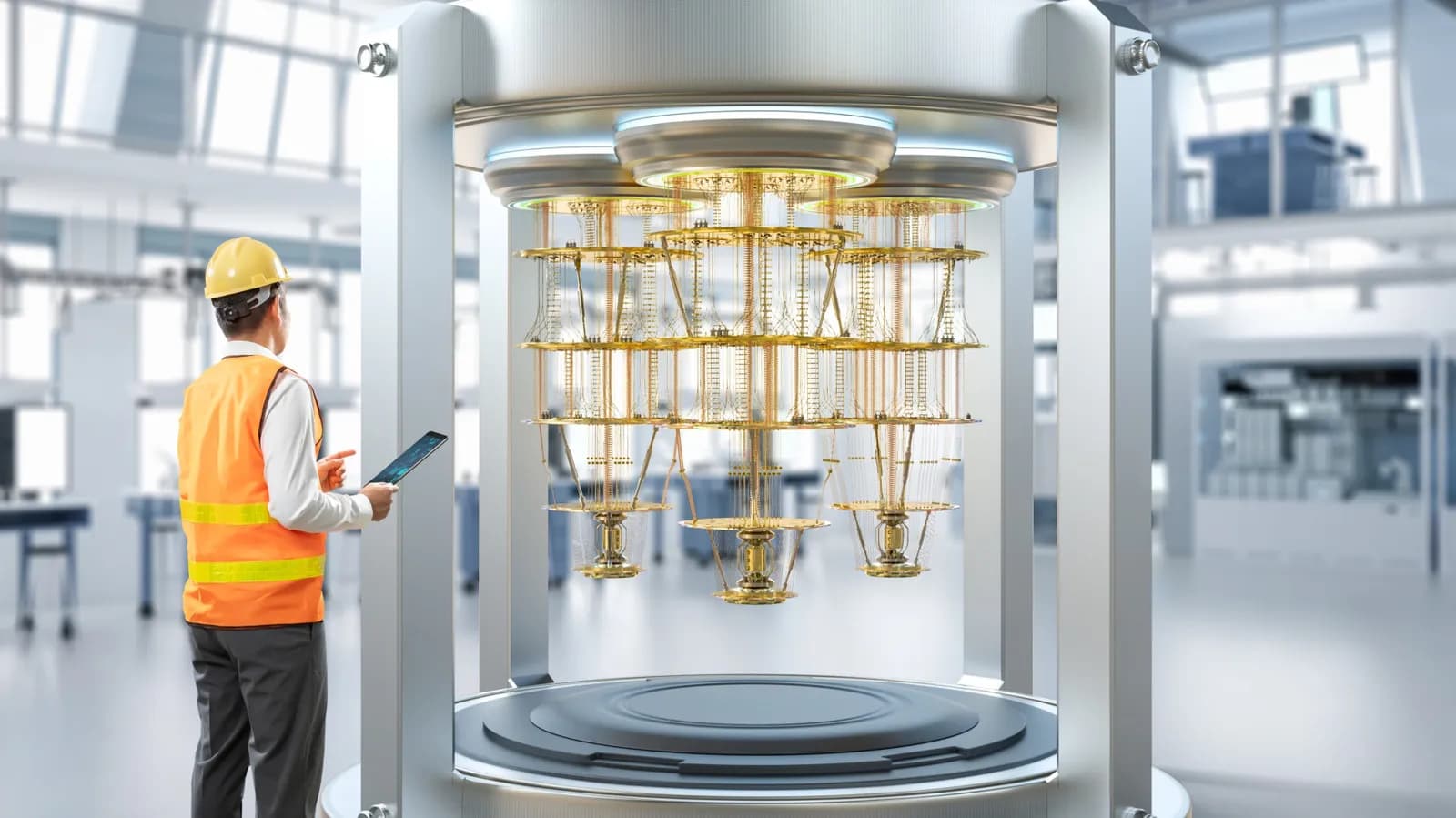
The architecture of a modern quantum computing system is dominated not by the tiny processor chip at the bottom, but by the towering, gold-plated cylindrical vessel that houses it. This device, known as a dilution refrigerator, uses a complex mixture of helium isotopes—specifically helium-3 and helium-4—to continuously draw heat away from the core. As the helium circulates through various stages of the cryostat, each dropping progressively lower in temperature, the system sheds thermal energy until the bottom plate reaches millikelvin temperatures.
To put this into perspective, these operating temperatures are significantly colder than the background temperature of deep space, which sits at roughly 2.7 Kelvin due to the lingering cosmic microwave background radiation. A superconducting quantum processor often operates at around 15 millikelvins, or roughly -273.13 degrees Celsius. At this extreme threshold, thermal fluctuations are minimized to the point where superconducting circuits can maintain their quantum states long enough to perform meaningful calculations.
The Engineering Challenge of Signal Routing
Keeping the processor cold is only half the battle; engineers must also interface with the outside world without introducing unwanted heat into the system. Every control wire, coaxial cable, and optical fiber running into the dilution refrigerator represents a potential thermal bridge that could conduct heat from room-temperature electronics down to the quantum chip. Designing attenuation and filtering strategies for these lines is one of the most rigorous hurdles in quantum systems engineering.
To solve this, hardware designers implement thermal anchoring at each stage of the dilution refrigerator. Cables are routed through successive temperature plates—from 50 Kelvin down to 4 Kelvin, then 1 Kelvin, and finally to the millikelvin stage—dropping their thermal load incrementally. Specialized attenuators and microwave filters are placed along these paths to strip out thermal noise while allowing the precise control pulses needed to manipulate the qubits to pass through to the processor.
Scaling Up: Beyond Single-Fridge Limits
As the quantum industry races toward fault-tolerant architectures featuring millions of physical qubits, the physical constraints of traditional dilution refrigerators are becoming a major bottleneck. A single cylindrical cryostat can only accommodate a finite amount of wiring and hardware surface area at its lowest temperature stage. Building bigger refrigerators is not a straightforward linear problem, as the cooling power required scales exponentially with the volume and thermal load of the system.
This limitation has forced hardware developers to rethink how quantum infrastructure will scale in the coming decade. Researchers are currently investigating modular cryogenic architectures, where multiple interconnected refrigerators share computational workloads, as well as the development of cryogenic control electronics that can operate at 4 Kelvin. By moving classical control hardware closer to the quantum processor inside the fridge, engineers hope to drastically reduce the sheer volume of cabling required to scale these systems up.
Software Implications for Thermal Efficiency
While cryogenic engineering is fundamentally a hardware discipline, the realities of extreme cooling also trickle down to the software and algorithmic layers. Because maintaining a dilution refrigerator is resource-intensive and prone to occasional thermal drift, quantum software stacks must be designed with hardware resilience in mind. Compilers and error-correction frameworks need to dynamically adapt to slight fluctuations in qubit fidelity caused by micro-variations in temperature and environmental noise.
Furthermore, developers working with quantum cloud services must account for the physical constraints of queue times and cooldown cycles. Unlike traditional cloud servers that can be spun up and down instantly, quantum hardware requires careful thermal management and calibration routines between execution runs. Understanding these physical realities helps developers write more efficient quantum circuits that minimize gate depth and reduce the cumulative error risks associated with extended runtime exposure.
The Future of Cryogenic Infrastructure
The pursuit of stable quantum computing has inadvertently driven a renaissance in cryogenic technology and low-temperature physics. Techniques originally developed solely for fundamental physics research are now being industrialized and refined to meet the commercial demands of quantum hardware developers. Companies specializing in cryogenic systems are finding themselves at the center of the deep tech boom, supplying the vital support infrastructure that makes quantum innovation possible.
Looking ahead, the success of the quantum computing paradigm may depend just as much on advancements in refrigeration thermodynamics as it does on qubit design. Whether through the refinement of pulse-tube coolers, the discovery of new superconducting materials that operate at higher temperatures, or entirely novel topological approaches that are inherently resistant to thermal noise, managing heat remains the ultimate gatekeeper of the quantum era.
Conclusion
Quantum computing is often discussed in terms of abstract mathematics, superposition, and entanglement, but its physical reality is anchored in extreme engineering. The journey from room-temperature user interfaces to processors operating colder than deep space showcases human ingenuity at its finest. As developers and engineers continue to push the boundaries of what is computationally possible, mastering the thermodynamics of absolute zero will remain foundational to building the resilient hardware of tomorrow.
Source: engadget.com