
Beyond Plain Text: Inside OpenAI's Pivot to Interactive Generative UI

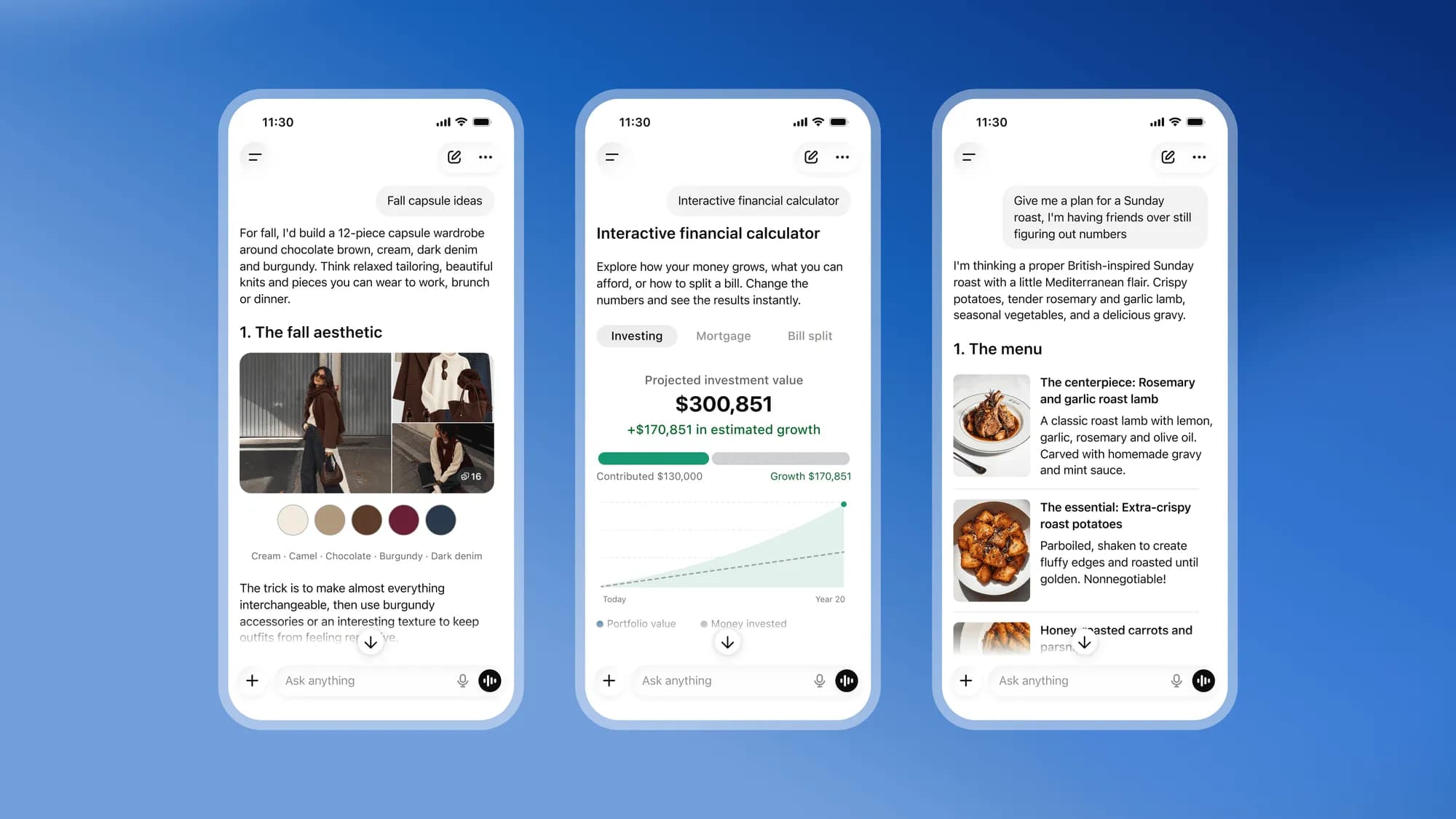
Since the initial wave of large language models took the tech world by storm, conversational artificial intelligence has been largely constrained by a surprisingly antiquated interface: the humble chat bubble. Whether summarizing dense research papers, debugging recursive algorithms, or analyzing financial spreadsheets, models have historically responded with unbroken walls of markdown text. OpenAI is now challenging that status quo by introducing a more visual and interactive user experience for ChatGPT, transforming the chatbot from a passive text generator into an adaptable, dynamic software environment.
This transition toward an "Intelligent UI" represents far more than an aesthetic facelift. By giving models the capacity to render interactive components—such as manipulable charts, interactive forms, dynamic widgets, and contextual controls—directly within the conversation thread, OpenAI is blurring the boundary between traditional application software and generative intelligence. For developers, designers, and everyday users, this shift marks the beginning of an era where user interfaces are no longer hardcoded into rigid layouts, but assembled on the fly to meet the immediate cognitive needs of the user.
Beyond the Wall of Text: The Evolution of Conversational Interfaces
When ChatGPT debuted in late 2022, its conversational simplicity was its greatest asset. Anyone capable of typing a message into an instant messenger could interact with cutting-edge artificial intelligence. However, as the underlying models grew dramatically more sophisticated, the limitations of pure chat quickly became apparent. Complex cognitive tasks rarely benefit from linear, chronological text dumps. A developer debugging application state, an analyst parsing quarterly figures, or a student solving calculus problems often needs visual diagrams, slider controls, and structured tables far more than another paragraph of explanatory prose.
Competitors across the AI ecosystem have spent the past year acknowledging this friction. Anthropic introduced its Artifacts feature to isolate code snippets, SVG graphics, and interactive prototypes into a dedicated side-panel workspace. Meanwhile, specialized developer tools have embraced canvas-like interfaces that let engineers orchestrate code blocks and visual flowcharts simultaneously. OpenAI’s update codifies this industry-wide realization: natural language is an exceptional input mechanism, but it is frequently an inefficient output format. A truly capable assistant needs to speak the language of graphical user interfaces just as fluently as human prose.
Decoding the "Intelligent UI": How Generative Front-Ends Work
Under the hood, generating interactive interfaces requires an LLM to coordinate multiple layers of computation in real time. Rather than outputting simple tokens destined for standard markdown parsing, the model outputs structured schemas or intermediate representations—frequently lightweight subsets of frameworks like React, HTML, or specialized JSON component trees. The client application then interprets these structures safely within an isolated sandbox, instantly mounting interactive components inside the conversation stream.
Consider a user asking the model to calculate mortgage amortization schedules or compare different cloud infrastructure hosting plans. Instead of reciting dry numerical rows or generating a static text table, an intelligent UI system can synthesize an interactive slider that recalculates monthly costs dynamically, or render an interactive bar chart with hover states and filter toggles. The model effectively becomes a runtime frontend compiler, generating bespoke micro-applications that run client-side without requiring dedicated backend microservices for every distinct feature.
Bridging Prompting and Software Design
The rise of dynamic, generative user interfaces fundamentally changes the conceptual model of software design. Traditionally, human interface designers and frontend engineers anticipate user journeys through deliberate user experience mapping. Every button, dropdown menu, and modal dialog is painstakingly wireframed, implemented, tested, and shipped in fixed releases. Software built this way is reliable, but it is inherently rigid—it cannot reshape itself based on idiosyncratic user questions or atypical workflows.
Generative UI introduces an entirely different philosophy: disposable, contextual software. In this model, an interface is summoned into existence for the sole purpose of solving an immediate query, and once that objective is met, the interface can either evolve or be discarded. This changes how developers must think about user state. Instead of navigating through multi-step forms or nested dashboard menus, users simply express their intent, and the interface configures itself around that intent. The challenge transitions from laying out pixels on a grid to establishing robust design systems and guardrails that allow an autonomous agent to render legible, accessible, and safe frontends on demand.
Implications for Web and Frontend Developers
For web engineers, OpenAI's latest direction carries significant technical implications. The shift highlights growing momentum behind frameworks and libraries specifically engineered for generative UI. Open-source ecosystems have already begun rallying around tools that permit language models to stream React Server Components and structured UI primitives straight to the client. Frontend developers who previously spent their days manually wiring up bespoke dashboards may find their roles pivoting toward building component catalogs that AI agents can intelligently orchestrate.
Furthermore, this architectural evolution emphasizes the growing convergence of frontend development and prompt engineering. If an LLM is responsible for deciding whether a user needs a visual table, a date-picker, or an SVG flowchart, developers must establish rigorous evaluation pipelines to ensure the model makes the right structural decisions. Ensuring visual consistency, enforcing strict design token standards, and maintaining responsive design principles across thousands of dynamically synthesized views will present non-trivial engineering challenges for teams building on top of modern AI platform APIs.
Usability Challenges and the Dark Side of Dynamic Interfaces
Despite the immense promise of interactive generative design, the paradigm is not without substantial hurdles. Predictability is one of the foundational tenets of human-computer interaction; users find comfort in muscle memory and consistent spatial layouts. If a user interface constantly morphs and rearranges itself unpredictably during a conversational session, it risks introducing cognitive overload and disorientation. An interface that is too fluid can quickly become chaotic and frustrating to navigate.
Security and accessibility represent two additional major friction points. Rendering arbitrary interactive components generated by an AI model introduces potential attack vectors, including cross-site scripting vulnerabilities or prompt injection exploits aimed at stealing sensitive session state. Sandboxing must be ironclad to prevent dynamically rendered components from accessing unauthorized browser APIs. Furthermore, dynamic components generated on the fly must strictly adhere to accessibility standards (such as ARIA attributes, keyboard navigation, and screen-reader compatibility)—an area where even human frontend developers frequently struggle, and where models can easily falter without explicit architectural constraints.
The Road Ahead: Autonomous Workspaces and Ambient AI
OpenAI’s push toward richer visual outputs reflects a broader strategic trajectory across the entire technology sector: conversational assistants are graduating into ambient workspaces. Moving beyond simple question-and-answer interactions is essential if AI platforms hope to capture deeper enterprise and creative workflows. In coding, data analysis, project management, and digital art, users spend the bulk of their time manipulating tools, tweaking visual assets, and exploring non-linear information structures.
As models continue to gain multimodal capabilities—processing vision, voice, code, and structured data simultaneously—the user interface of tomorrow will likely resemble an adaptive canvas rather than a messaging thread. The chatbot window may soon feel like an artifact of early AI history, superseded by hybrid workspaces that synthesize custom spreadsheets, interactive code sandboxes, and visual canvases on the fly. OpenAI’s introduction of dynamic visual components is an early, critical milestone along that evolutionary path.
Closing Takeaway
The introduction of interactive, visual outputs to ChatGPT marks a pivotal step in closing the gap between conversational AI and functional software utility. By abandoning the limitations of static text, OpenAI is charting a course toward dynamic, just-in-time interfaces that mold themselves to human intent. While significant challenges regarding predictability, accessibility, and interface stability remain to be solved, the lesson for software engineers is clear: the future of user interfaces will not just be scripted by developers—it will be actively generated in real time.
Source: wired.com