
Bio-Inspired Whiskers Give Micro-Drones Tactile Senses to Navigate in Total Darkness

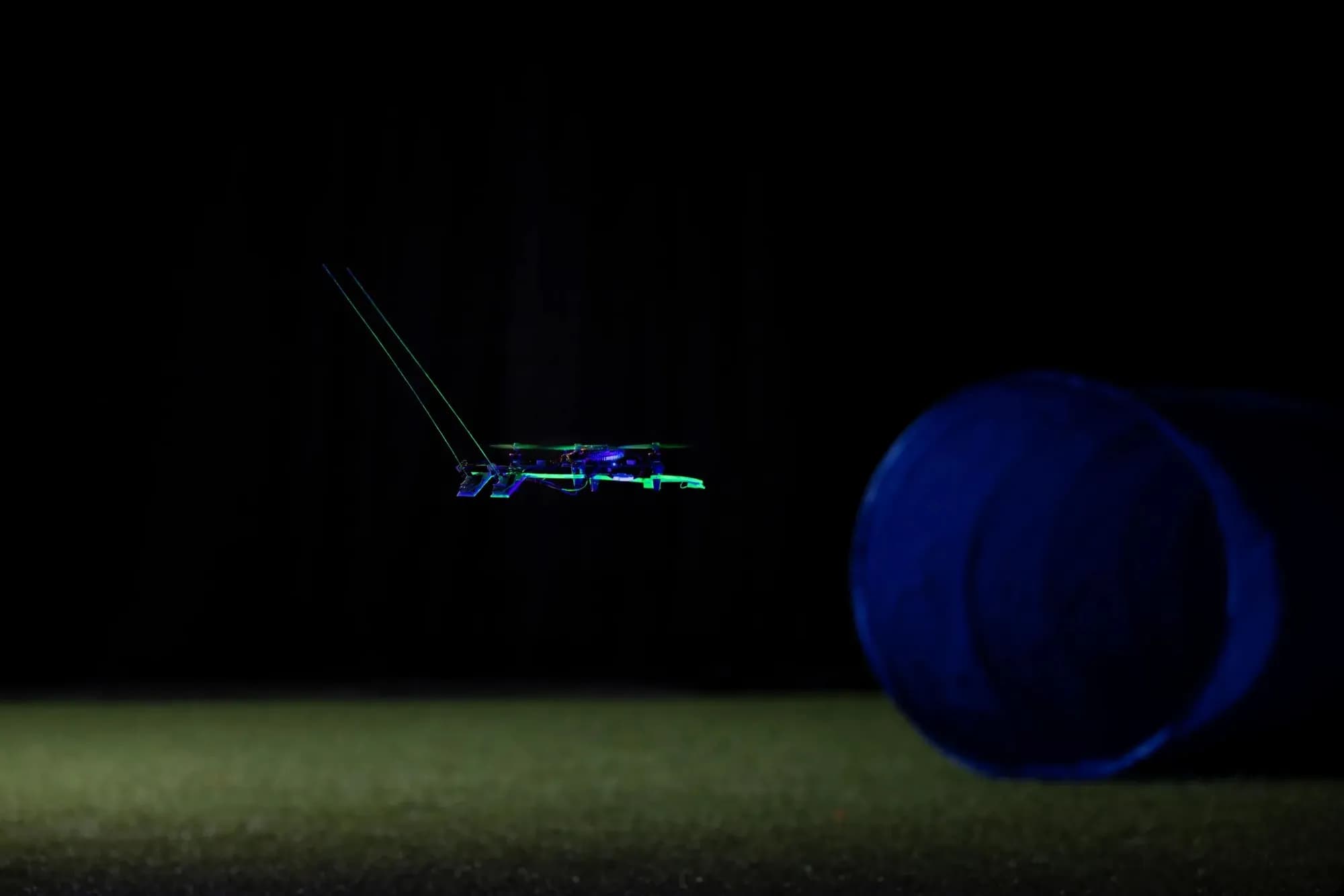
Autonomous aerial robotics has advanced at a breakneck pace over the past decade, yet the vast majority of unmanned aerial vehicles (UAVs) remain tethered to a single fundamental assumption: they need clear vision to survive. In typical operating conditions, drones rely on sophisticated computer vision pipelines, optical flow sensors, and light detection and ranging (LiDAR) scanners to understand where they are and avoid collisions. When those visual cues vanish—such as inside smoke-filled collapsed structures, pitch-black subterranean conduits, or dust-choked disaster zones—even the most advanced multirotor systems frequently fail. In these high-stakes rescue scenarios, human operators need tiny, agile drones capable of slipping through rubble, but miniaturizing heavy sensing gear while operating in zero-light conditions has long presented an engineering bottleneck.
To solve this dilemma, researchers have turned their attention away from high-resolution digital imaging and toward evolutionary biology. Nocturnal animals, notably felines and rodents, do not depend solely on their eyes to traverse cramped, lightless terrain; they leverage specialized tactile hairs known as vibrissae, or whiskers. By adapting this mechanical sensing philosophy into lightweight, synthetic tactile arrays, roboticists are providing micro-drones with an entirely new sensory modality. Instead of fighting the dark with heavy spotlights and computationally expensive infrared rigs, these micro-UAVs can now feel their way through complex obstacles with extraordinary speed and precision.
The Limits of Optical Navigation in Hostile Environments
Modern autonomous flight has largely been built around the concept of visual-inertial odometry (VIO) and visual Simultaneous Localization and Mapping (SLAM). These algorithms interpret sequential camera frames to calculate an aircraft’s position in three-dimensional space while mapping the surrounding environment. While this paradigm works wonders under daylight conditions or inside well-lit warehouses, it degrades rapidly when exposed to environmental hazards. Smoke, particulate matter, reflective surfaces, and total darkness degrade optical data feeds, causing vision algorithms to lose tracking and resulting in catastrophic flight drifts or direct collisions.
The traditional solution to zero-visibility flight has been active sensing payloads like LiDAR, ultrasonic transducers, or millimeter-wave radar. However, micro-scale drones operate under harsh Size, Weight, and Power (SWaP) constraints. A rescue micro-drone small enough to fit in the palm of a hand might only carry a battery rated for single-digit minutes of flight time. High-frequency laser scanners and accompanying compute boards consume enormous amounts of energy, generating heat and rapidly draining onboard reserves. Ultrasound arrays, while lighter, often suffer from wide beam dispersion and surface specular reflection, making them unreliable when picking out complex, fine-grained hazards like tangled rebar or splintered framing.
Bio-Inspired Engineering: Emulating Feline Tactile Sensing
Nature solved the problem of navigating cluttered, unlit environments hundreds of millions of years ago. Nocturnal predators, including domestic and wild felines, rely heavily on their whiskers to assess tight openings, detect subtle changes in nearby airflow, and register physical contact well before their body strikes an obstacle. Each whisker functions as a mechanical lever: minimal contact at the tip amplifies mechanical forces at the base, where high-density mechanoreceptors convert physical displacement into rapid neurosensory signals.
Translating this biological mechanism to micro-drones requires replicating both the structural compliance of natural vibrissae and the acute sensitivity of follicle receptors. Fabricated from lightweight, highly flexible materials such as carbon fiber composites, superelastic nitinol alloys, or durable elastomeric polymers, artificial whiskers can withstand repeated deflections without suffering permanent deformation. Mounted strategically around the drone's perimeter or along protective propeller cages, these slender appendages project outward, providing a physical buffer zone that triggers navigational adjustments before the aircraft’s airframe or spinning rotors make contact with a barrier.
How Whisker-Based Micro-Sensors Work on Drones
The electronic architecture behind artificial whiskers is remarkably elegant and resource-efficient. At the root of each synthetic filament sits a base sensor capable of measuring tiny mechanical shifts. Common implementations employ micro-electromechanical systems (MEMS), miniature strain gauges, hall-effect magnetic sensors, or piezoelectric elements. When a whisker brushes against a wall, a hanging wire, or an uneven surface, the resulting deflection bends the base sensor, generating an immediate, proportional voltage change.
Unlike high-resolution camera feeds that deliver millions of bytes per frame, whisker sensor outputs are inherently sparse and stream at low computational cost. A complete array of synthetic whiskers might yield only a handful of analog channels or low-bitrate digital readings. Because the physical world does the heavy lifting of spatial sampling through direct mechanical deflection, the drone’s flight controller avoids the need to parse dense pixel arrays or execute heavy matrix multiplications to confirm whether an obstacle is approaching. The signal is nearly instantaneous, providing deterministic response times measured in single-digit milliseconds.
Software and Algorithm Implications: Low-Latency Reactive Flight
For embedded systems developers and robotics programmers, tactile whisker sensors encourage a return to low-latency, reactive control loops reminiscent of Rodney Brooks’ classical subsumption architecture. Rather than routing sensor data through multi-gigabyte neural networks or resource-intensive SLAM pipelines, tactile responses can be handled directly at the micro-controller firmware level. If a whisker sensor registers a deflection exceeding a predefined threshold, the low-level flight control loop can immediately execute an evasive vector or wall-following routine.
This lightweight processing profile fundamentally changes the hardware profile required for autonomous micro-drones. Developers do not need to outfit small platforms with dedicated neural processing units (NPUs) or power-draining graphic processors just to avoid collisions. A standard 32-bit ARM Cortex-M microcontroller can easily manage motor mixing, attitude estimation, and multiple whisker interrupt routines simultaneously. When higher-level mapping is desired, the tactile deflection vectors can be merged into lightweight occupancy grids, updating localized spatial maps with absolute coordinates based on verified physical contact.
Search and Rescue and Industrial Inspection Applications
The primary driver behind this tactile sensory breakthrough is life safety. In the wake of earthquakes, structural collapses, or subterranean industrial accidents, search and rescue teams often encounter narrow crevices, collapsed stairwells, and ducts that are far too dangerous for human entry and impossible for canine teams to navigate. Miniature drones fitted with bio-inspired whiskers can slip through broken masonry in total darkness, mapping safe pathways, verifying structural stability, and hunting for thermal signatures or audio traces of survivors.
Beyond emergency response, industrial asset management stands to gain substantially. Inspecting underground utility shafts, nuclear cooling towers, active sewage conduits, and petrochemical piping often requires navigating confined, dark, and often particulate-heavy spaces. Sending conventional inspection drones into these environments typically demands high-intensity lighting rigs that rapidly deplete batteries and kick up blinding clouds of dust. Tactile-guided drones, by contrast, can safely skim along pipeline walls, performing close-proximity ultrasonic or crack inspections while feeling their way along the interior curves without relying on ambient lighting.
Challenges, Durability, and Future Horizons
Despite the immense promise of mechanical tactile sensing, deploying whiskers on high-speed aerial platforms introduces clear engineering trade-offs. The first challenge is aerodynamic interference. Propeller downwash creates turbulent, high-velocity airflow around the perimeter of a multirotor. Whiskers must be engineered to filter out continuous aerodynamic drag and rotor wash so that ambient vibration is not misidentified as a physical obstacle. Developers solve this using tailored mechanical damping, frequency-based bandpass filtering, and adaptive baseline calibration algorithms in firmware.
Durability under aggressive operating conditions represents another hurdle. In severe industrial or disaster environments, whiskers run the risk of snagging on exposed wiring, sharp jagged metal, or adhesive debris. Researchers are investigating quick-release magnetic couplings and self-healing or shape-memory polymers that allow whiskers to flex past extreme angles without snapping or disabling the craft. Looking forward, the most robust autonomous platforms will likely adopt a hybrid approach: using lightweight visual sensors whenever ambient conditions permit, but gracefully falling back to tactile bio-whiskers the moment the environment plunges into dust, smoke, or total darkness.
A Tactile Leap for Autonomous Robotics
The development of cat-like whiskers for micro-UAVs underscores an enduring lesson in modern engineering: sometimes the most elegant technological solutions come not from adding more raw computing horsepower, but from taking cues from the biological designs refined by nature. By freeing tiny aircraft from their total dependence on optical clarity, tactile sensing unlocks realms previously inaccessible to autonomous flight. As these bio-inspired sensor arrays become more resilient and simpler to integrate, rescue operators and robotics engineers will gain a powerful, dependable new tool capable of navigating unseen hazards where traditional machines simply cannot fly.
Source: wired.com