
Epic Re-engineers Its Games Launcher for Speed, Taking Direct Aim at Steam

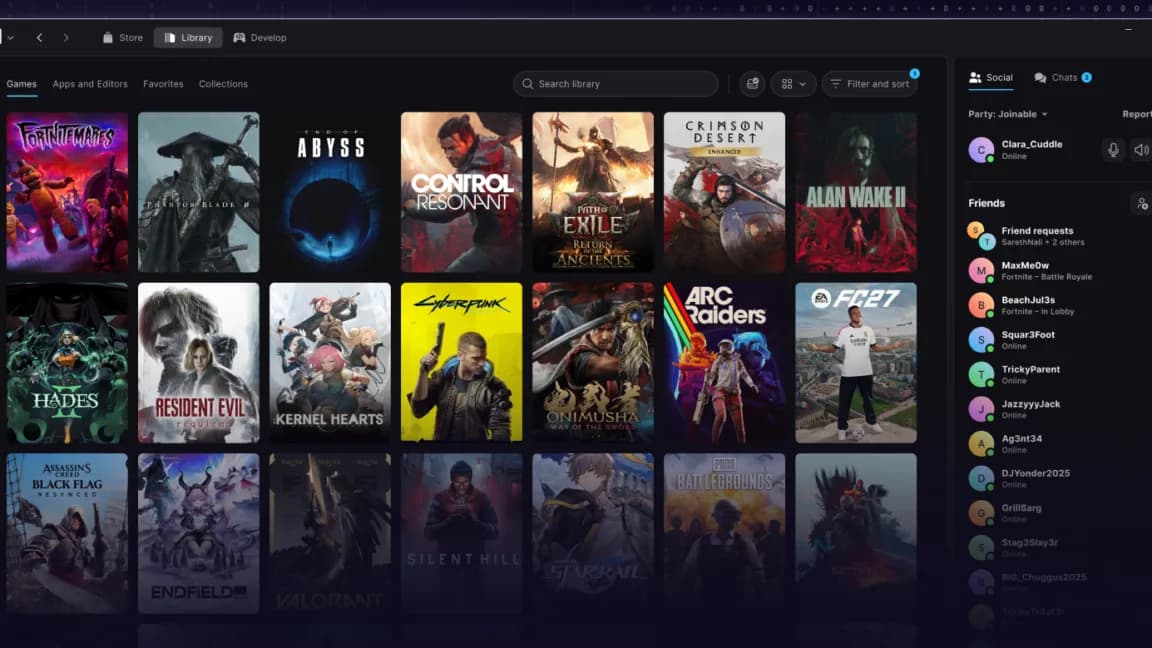
For years, desktop storefront clients have been a persistent source of irritation among PC gamers and software engineers alike. Once envisioned as lightweight digital distribution utilities, modern store clients have steadily ballooned into memory-heavy, web-based environments burdened with embedded browsers, social feeds, and telemetry suites. Epic Games, whose original launcher frequently drew criticism for sluggish responsiveness and high system resource usage, has now rolled out a major preview update designed to turn performance into a core competitive advantage. According to Epic, this modern rewrite doesn't just cut down on its own previous bloat—it aims to be measurably faster than Valve's entrenched market leader, Steam.
The Long Shadow of Desktop Client Bloat
To understand why a launcher overhaul is drawing such intense scrutiny, one must look at the evolution of modern PC desktop software. Over the past decade, a quiet architectural shift transformed native desktop applications into web-technology wrappers. Driven by frameworks like the Chromium Embedded Framework (CEF) and Electron, engineering teams across the industry prioritized cross-platform feature parity, shared web codebases, and rapid frontend iteration over raw execution speed and low memory footprints.
While this approach made business sense for maintaining identical storefront layouts across multiple operating systems, the end-user experience often suffered. Game launchers frequently consumed hundreds of megabytes of RAM while idling, took several seconds to render basic inventory screens, and introduced noticeable input latency. Epic's original launcher was particularly susceptible to these performance pitfalls, regularly criticized for slow startup times, unresponsive navigational tabs, and inefficient asset caching compared to leaner desktop software.
Rebuilding Under the Hood: Epic's Bold Performance Claims
In response to lingering community feedback, Epic has launched a brand-new "Preview" build of the Epic Games Launcher, showcasing a completely modernized client architecture. Company representatives assert that this revamped application delivers dramatic latency reductions across standard user journeys—including cold starts, library page rendering, and catalog browsing. In internal benchmarks shared alongside the announcement, Epic went so far as to claim that its revised client operates faster and feels more responsive than Steam, the undisputed benchmark for digital PC storefronts.
Valve’s Steam client underwent its own comprehensive UI overhaul in recent years, transitioning heavily into a web-driven architecture built atop Chromium components. While that redesign brought modernized chat systems, rich game hubs, and improved accessibility, it also opened the door for competitors to argue that Valve’s client had lost some of its historical nimbleness. By positioning their preview app specifically against Steam's benchmarks, Epic is signaling that application performance and micro-interactions are now front-line marketing weapons in the ongoing battle for PC gaming market share.
The Architecture Challenge: Web Frameworks vs. Native Optimization
Achieving tangible performance gains in desktop store clients is notoriously difficult because such applications operate as hybrid software: they must manage low-level system tasks like background file downloads, disk decompression, and local DRM checks, while simultaneously rendering dynamic, web-driven commercial storefronts. When engineering teams build these systems primarily with heavy web views, every transition between local OS operations and remote web content incurs overhead.
While Epic has not released a comprehensive breakdown of every internal dependency in the preview client, achieving speeds that rival or beat competing clients generally requires a fundamental rethinking of render loops, aggressive multi-threaded caching, and a tighter separation between native background services and user interface layers. By offloading intensive rendering tasks from heavy web pipelines and optimizing how localized metadata is stored on the user's hard drive, a modern client can eliminate the stutter and UI freezing that previously plagued navigation through large game libraries.
Developer and Ecosystem Implications: Why Launcher Performance Matters
For independent game developers and major publishers who distribute through third-party platforms, the speed of a storefront client is far more than a minor quality-of-life detail. The digital launcher represents the primary top-of-funnel discovery engine for games. When a store interface lags, stutters, or struggles to load promotional assets, user engagement drops, and potential purchasers abandon their search before even reaching a title's product page.
Furthermore, background client footprint directly impacts the runtime performance of games themselves. On budget or mid-range gaming rigs, an oversized desktop client running background telemetry, store carousels, and persistent animation cycles can steal valuable CPU cycles and RAM from running titles. If Epic can consistently deliver a lean, ultra-responsive launcher that quietly steps aside when a game executes, it makes the platform inherently more attractive to both hardware-conscious players and developers keen to maximize their titles' available hardware budget.
The Preview Reality Check: Bugs, Stability, and User Trust
Despite the headline-grabbing performance comparisons, Epic was careful to temper expectations by issuing a candid disclaimer: the newly released preview client is experimental and will inevitably contain bugs. Early adopters opting into the preview channel must contend with unfinished features, potential layout glitches, and the risk of unexpected crashes during library navigation or checkout procedures.
Navigating this public testing phase carries substantial strategic risks. The PC community has historically viewed launcher software with a degree of skepticism, often seeing competing storefronts as redundant friction required merely to access specific titles. If the preview build suffers from broken download queues, corrupted installation states, or game launch failures, the goodwill earned by speed improvements could quickly be eroded by frustrations over fundamental software reliability. Delivering rock-solid stability during real-world edge cases—such as spotty network connections or interrupted disk writes—remains the ultimate hurdle for any client rewrite.
Looking Ahead: The Battle for the PC Gaming Desktop
The rollout of this high-performance preview signals a broader maturation in Epic's strategy. For years, the company relied primarily on aggressive tactics to capture market share, pouring vast resources into free weekly game giveaways and securing controversial third-party exclusivity deals. However, sustained long-term adoption requires providing a daily user experience that players actively enjoy using rather than tolerate out of necessity.
By prioritizing raw speed, streamlined navigation, and a noticeably snappier interface, Epic is attacking one of the most stubborn criticisms that has followed its desktop platform since its debut. If the engineering team can iron out the preview's rough edges and translate these experimental optimizations into a rock-solid stable release, it could force the entire industry—including Valve and other digital storefront operators—to reconsider their own desktop architectures, kicking off a long-overdue race toward lighter, faster, and more efficient PC gaming software.
Source: arstechnica.com