
Formlabs Brings Stereolithography to the Masses with the Form Studio 1

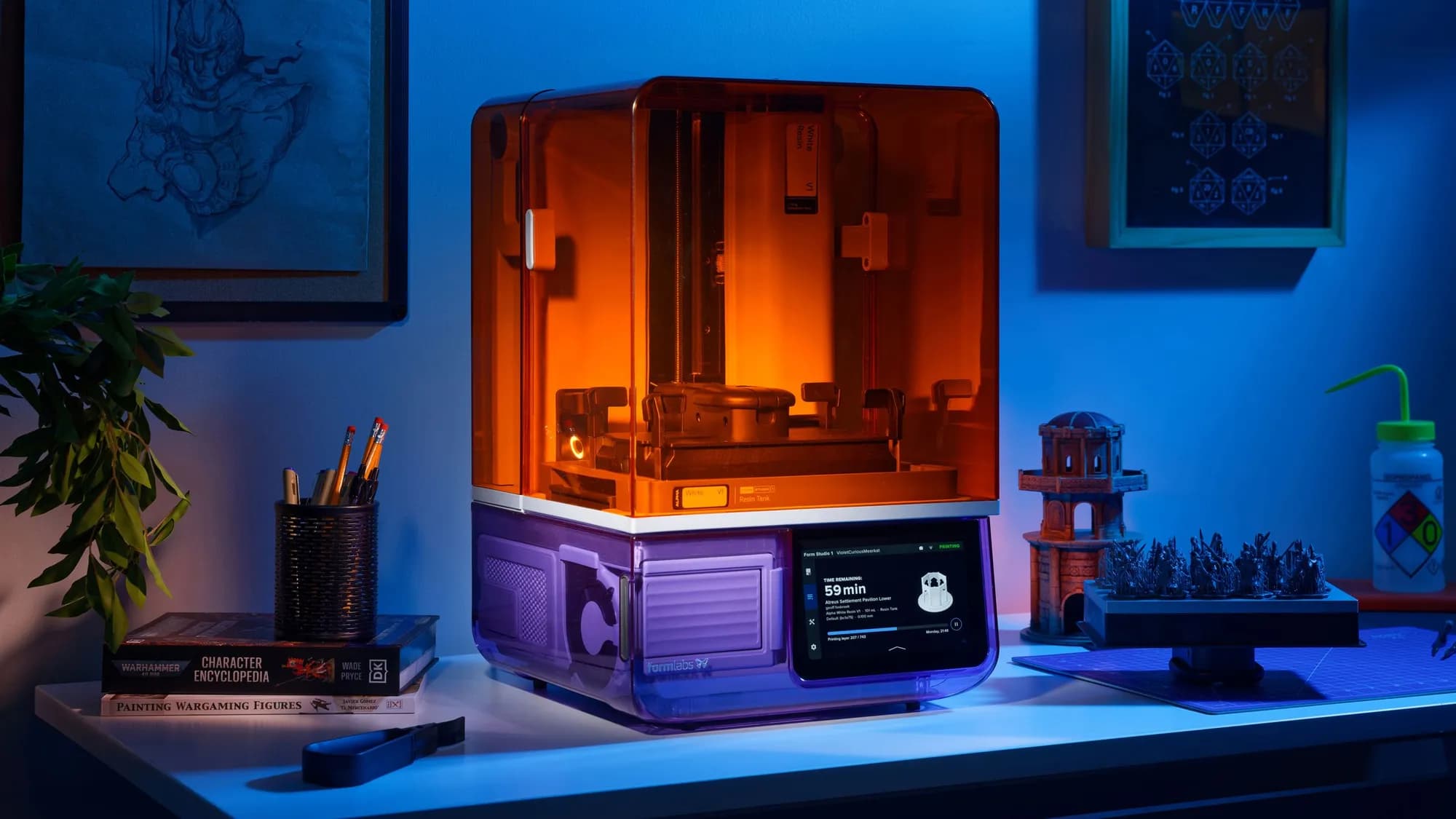
The Evolution of Desktop Prototyping
For years, desktop 3D printing has been broadly divided into two distinct worlds. On one side, we have fused deposition modeling (FDM) machines, which are cheap, widely accessible, and relatively easy to clean, but often struggle with fine details and smooth finishes. On the other side sit stereolithography (SLA) and masked stereolithography (MSLA) resin printers. These ultraviolet-curing machines deliver incredible precision, smooth surfaces, and microscopic fidelity, but they have traditionally demanded specialized ventilation, messy post-processing workflows, and a higher tolerance for chemical odors.
Formlabs has historically catered to professionals, dental labs, and engineering workshops with high-end machinery that prioritizes industrial reliability and material accuracy over budget constraints. However, the introduction of the Form Studio 1 at a sub-$700 price point signals a strategic pivot toward a much broader audience. By redesigning the desktop resin experience to fit into typical domestic or creative spaces without requiring industrial extraction hoods, the company is attempting to bridge the gap between niche maker tools and mainstream consumer appliances.
Decoding the Form Studio 1 Experience
At its core, the Form Studio 1 is built to remove the intimidation factor that normally deters casual users from trying resin 3D printing. Traditional resin printers often feel like miniature chemistry labs, requiring users to handle liquid polymers with heavy gloves, wash prints in isopropyl alcohol, and cure them in separate UV boxes. While specific internal mechanics and chemical formulations of the new machine are tailored for ease of use, the overarching design philosophy focuses on containment and guided user interaction.
Pricing plays a critical role in this accessibility push. At $699, the hardware enters a fiercely competitive bracket traditionally dominated by budget-oriented MSLA brands. Yet, Formlabs brings its proprietary software ecosystem and material science background to the table. The objective is to deliver a plug-and-play experience where slicing a 3D model and sending it to print feels as straightforward as printing a document on a standard 2D inkjet printer, minimizing the trial-and-error calibration loops that frustrate beginners.
Addressing the Elephant in the Room: Resin Odor and Safety
One of the most persistent barriers to adoption for desktop resin printers has been the chemical smell. Photopolymers release volatile organic compounds (VOCs) and distinct chemical odors during the printing and washing stages, making many users banish their machines to drafty garages, sheds, or heavily ventilated basements. Living spaces and home offices are rarely equipped with the industrial HVAC setups required to comfortably scrub these fumes from the air.
By engineering the Form Studio 1 to emit significantly less odor, Formlabs is directly tackling the environmental friction of resin printing. While complete chemical neutrality is difficult to achieve with UV-curable polymers, minimizing the stench means the printer can genuinely sit on a standard office desk or in a corner of a living room without driving occupants away. This reduction in airborne disruption is arguably just as important as software refinement for expanding the addressable market beyond hard-core enthusiasts.
Implications for Makers, Designers, and Prototypers
For independent creators, industrial designers, and software engineers who enjoy building physical hardware, having reliable access to high-resolution prototyping at a desk changes the iteration cycle. When you can quickly spin up a complex mechanical part, a miniature figurine, or an intricate custom enclosure right next to your workstation, the feedback loop tightens dramatically. You no longer need to outsource high-detail prints or endure the coarse layer lines typical of cheap FDM machines.
Furthermore, lowering the barrier to entry for resin technology invites more software developers and digital artists to experiment with physical computing and custom hardware peripherals. When hardware fabrication becomes as approachable as software deployment, the line between digital creation and physical manufacturing blurs further. This democratization of professional-grade surface finish encourages rapid prototyping for everything from custom keyboard cases to smart home sensor housings.
Market Dynamics and Competitive Pressures
The sub-$1,000 desktop printing market is already intensely crowded. Brands like Elegoo, Anycubic, and Phrozon have driven hardware costs down through rapid iteration and economies of scale, offering massive build volumes and high-resolution screens for surprisingly low prices. However, these budget options often require users to tinker with settings, manually troubleshoot failed prints, and manage messy post-processing workflows independently.
Formlabs is positioning the Form Studio 1 not as a cheap commodity tool, but as a refined consumer product where the value proposition lies in software polish, material reliability, and user experience. By trading some raw specification metrics for streamlined ergonomics and reduced chemical hassle, Formlabs is betting that a significant segment of the market values convenience and predictability over raw hardware specs. This mirrors the trajectory of personal computing, where appliance-like simplicity eventually captured a much larger audience than open-ended tinker boxes.
Looking Ahead: The Consumerization of Digital Fabrication
As 3D printing technology matures, the industry's growth increasingly relies on removing friction for non-expert users. The transition from esoteric hardware requiring specialized technical knowledge to mainstream consumer electronics is slow, but product launches like the Form Studio 1 mark important milestones along that path. If resin printing can truly become clean, quiet, and reliable enough for ordinary living spaces, it opens the door for widespread adoption in education, home crafts, and desktop engineering.
The broader tech landscape will be watching to see how consumers and hobbyists respond to this hardware. If successful, it could prompt competitors to rethink their product roadmaps, placing greater emphasis on air filtration, software ecosystems, and user-friendly design over mere price wars and build-volume escalation. Ultimately, making digital fabrication invisible, frictionless, and accessible is the key to unlocking its true potential across every creative discipline.
Source: wired.com