
Modular Ambition Meets Real Power: Upgrading Framework's Compact Laptop With Modern Silicon

The Evolution of Modular Ultraportables
When Framework first entered the personal computing market, the company set out to challenge one of the consumer electronics industry's most entrenched orthodoxies: that modern laptops must be sealed, glued, and effectively disposable. While competitors pushed for razor-thin enclosures at the cost of soldered memory and glued-in batteries, Framework established a loyal following among developers, engineers, and right-to-repair advocates by demonstrating that modular design could coexist with modern aesthetics and everyday usability.
As the company expanded its catalog beyond its initial 13-inch chassis into larger desktop-replacement form factors, it also turned its attention toward the ultraportable segment. The vision for a smaller 12-inch model was clear from the start: create an ultra-compact, resilient machine that could serve educational users, travelers, and lightweight productivity tasks. However, early iterations of smaller form factors often walked a tightrope between cost and capability, frequently constrained by low-power processors that risked relegating the hardware to glorified web-browsing duty.
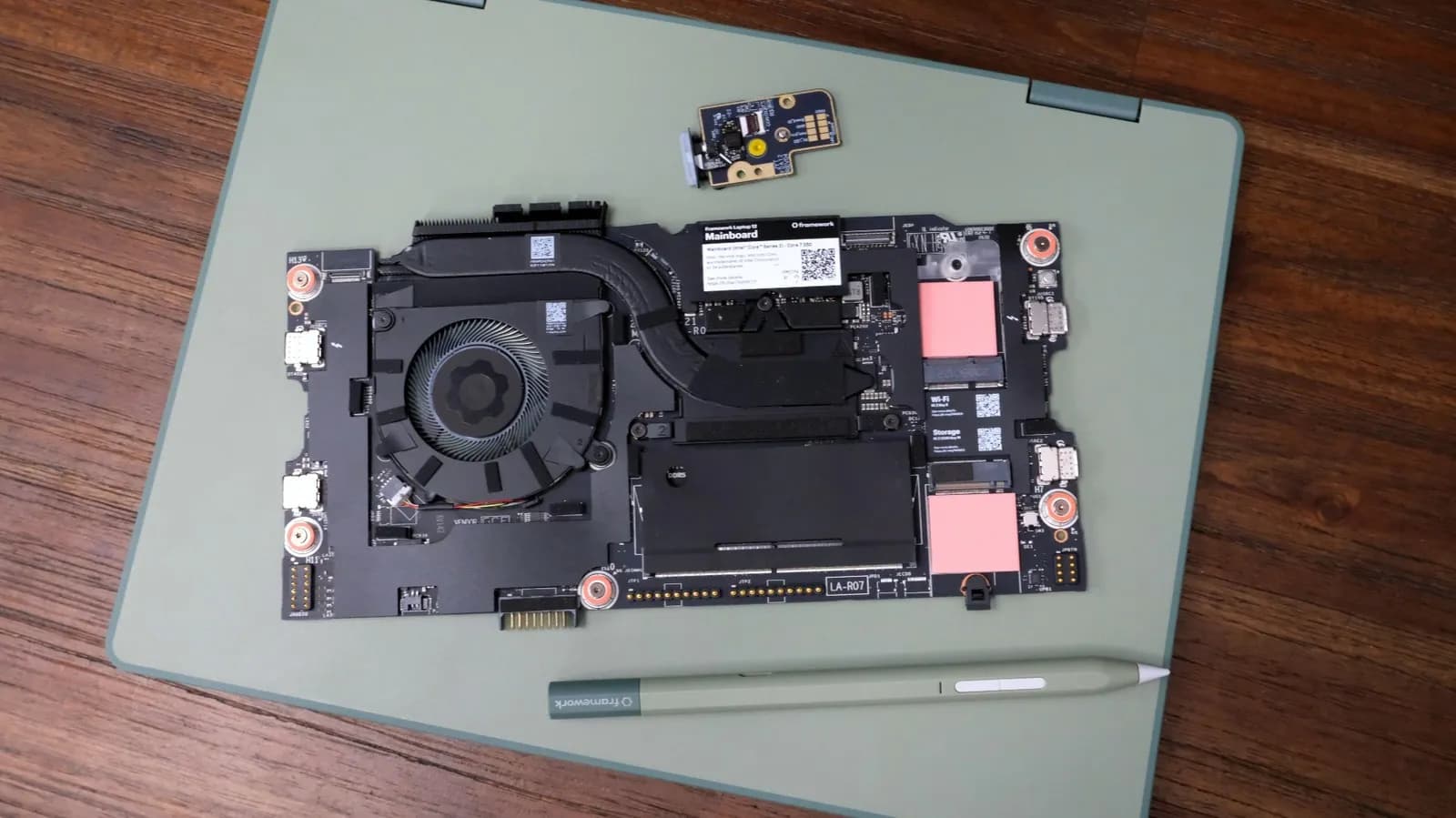
The latest silicon refresh alters that calculation entirely. By integrating modern flagship-tier processing power into its diminutive chassis, the updated Framework 12-inch machine transitions from an educational curiosum into a fully capable, professional-grade daily driver, tackling the foundational compromises that previously held ultraportable modular systems back.
Addressing the Performance Bottleneck
The primary critique leveled at lightweight, budget-adjacent portable computers has historically centered on compute headroom. When hardware relies on entry-level architecture, the daily developer workflow quickly grinds to a halt. Compiling code, running containerized microservices in Docker, handling dense local databases, and keeping dozens of memory-intensive browser tabs open simultaneously can rapidly overwhelm modest silicon, leaving users frustrated by thermal throttling and sluggish responsiveness.
By transitioning to contemporary, high-efficiency hybrid architectures—specifically modern high-tier Intel Core processors—the updated machine addresses this longstanding limitation. The influx of dedicated performance and efficiency cores, paired with significant improvements in integrated graphics and neural processing units, transforms the device's operational envelope. Tasks that once caused sustained fan noise and stutter now execute with the fluid responsiveness expected from high-end corporate workstations.
Equally critical is the generational leap in energy efficiency. Early ultraportables running desktop-class code frequently suffered from rapid battery drain or aggressive clock-speed reductions to keep skin temperatures manageable. The latest silicon architecture offers superior performance-per-watt curves, allowing the machine to sustain demanding computational bursts without compromising on-the-go longevity or cooking the user's palms during compile cycles.
Why Compact Modularity Resonates With Developers
Software engineers, system administrators, and technical road warriors have long harbored an affinity for smaller, highly resilient hardware. The enduring popularity of vintage, highly upgradeable sub-notebooks demonstrated an unmet demand in the market: professionals frequently want a travel machine that can easily slide into a daypack, withstand rigorous use, and still offer full control over internal components.
For developers, the modular ethos of Framework offers concrete practical advantages over mainstream ultraportables:
- Customizable I/O Layouts: The ability to hot-swap expansion cards means an engineer can tailor the chassis ports to their immediate context, whether switching from dual Type-C and USB-A adapters at a desk to micro-SD and HDMI modules during field deployments.
- User-Serviced Storage and Memory: Unlike the prevailing trend of non-volatile memory and RAM permanently fused to the logic board, modular construction ensures that storage drives can be swapped in seconds and memory expanded as developer requirements scale.
- Seamless Open-Source Support: Hardware modularity naturally aligns with software freedom. Framework has consistently maintained robust Linux support, working directly with upstream distributions to ensure kernel-level compatibility for power management, Wi-Fi modules, and display scaling.
When combined with genuine flagship processing speeds, these characteristics elevate the compact chassis into an ideal companion for technical operations, on-call debugging, and remote development environments.
The Engineering Hurdle: Thermal Density in Small Enclosures
Squeezing top-tier compute silicon into a 12-inch footprint is not merely a matter of swapping a socket on a motherboard; it presents formidable mechanical and thermal challenges. In a sealed ultrabook, industrial designers often use the aluminum exterior as a massive passive heat sink or route heat through ultra-thin vapor chambers pressed tightly against glued components. Framework, by contrast, must design around modularity, leaving mechanical clearance for accessible screws, swappable ports, and replaceable thermal modules.
Balancing these competing design imperatives requires sophisticated airflow modeling and acoustic tuning. Engineers had to ensure that the cooling system could dissipate the thermal load of prolonged CPU spikes without producing an abrasive high-pitched whine or creating localized exterior hotspots. Furthermore, because internal components are intended to be serviced by ordinary consumers, thermal paste application and heat-pipe seating must remain robust across repeated disassembly cycles.
The successful integration of modern multi-core chips into this chassis demonstrates that the engineering penalties of repairability continue to shrink. Modularity does not require thick, cumbersome plastics or excessive bulk; thoughtful mechanical packaging can yield a sleek, travel-friendly chassis capable of managing serious thermal dissipation.
Challenging the Disposable Hardware Economy
Beyond individual developer benchmarks, the maturation of Framework's smaller platform sends an important message to the wider electronics industry. For over a decade, original equipment manufacturers (OEMs) have claimed that consumer demand for thin, lightweight devices inherently mandates glued batteries, soldered flash memory, and restricted repair access. The modern upgradeable ultraportable systematically disproves that narrative.
In commercial and educational fleets, laptops are typically discarded after three to four years simply because the battery degrades or the non-upgradeable storage becomes insufficient for updated software stacks. By offering modular mainboard replacements, Framework enables an entirely different lifecycle: institutions and individuals can retain screens, keyboards, webcams, and enclosures while periodically upgrading the internal compute engine as silicon architectures advance.
This paradigm shift dramatically reduces electronic waste and decouples software obsolescence from physical hardware deterioration. When an older processor becomes inadequate for production workloads, the core shell of the machine remains useful, while the retired mainboard can easily be repurposed into a home server, standalone media unit, or lightweight network appliance using publicly available 3D-printable enclosures.
The Road Ahead for Modular Computing
While the infusion of serious processing power solves the biggest functional drawback of the compact platform, several frontiers remain for modular hardware. Screen technology, keyboard tactile profiles, and battery chemistry continue to evolve rapidly. As users demand brighter OLED options, higher-resolution panels with variable refresh rates, and even longer untethered runtimes, Framework will need to ensure that its modular ecosystem keeps pace without breaking mechanical backward-compatibility.
Furthermore, the competitive landscape is shifting rapidly with the resurgence of alternative instruction set architectures, such as ARM-based chips that offer exceptional energy efficiency in portable form factors. The ultimate realization of the modular computing promise will involve giving users the freedom not just to upgrade within an x86 silicon generation, but to seamlessly choose between disparate processor architectures on the exact same chassis frame.
For now, the pairing of robust, modern processing muscle with a compact, fully repairable chassis marks a pivotal milestone. It proves that engineers and power users no longer need to accept structural compromises or sealed obsolescence in exchange for portable, everyday performance. The ultraportable has finally grown up, and it does so on the user's terms.
Source: engadget.com