
Steam Overhauls Progression Tracking with Achievement Sets to Protect 100 Percent Clears

Re-Engineering the Milestone Architecture of PC Gaming
For more than a decade, digital storefronts and gaming ecosystems have relied on achievements as a primary vector for player engagement, replayability, and community status. On Valve's Steam platform, dedicated players have long pursued the coveted 100 percent completion status—a digital badge of honor displayed prominently on user profiles and showcase showcases. However, an enduring frustration among completionists has been the platform's monolithic tracking model: whenever a studio releases downloadable content (DLC) containing new unlocks, an existing player's pristine completion record instantly drops below the threshold, revoking their hard-earned ribbons and perfect-game badges.
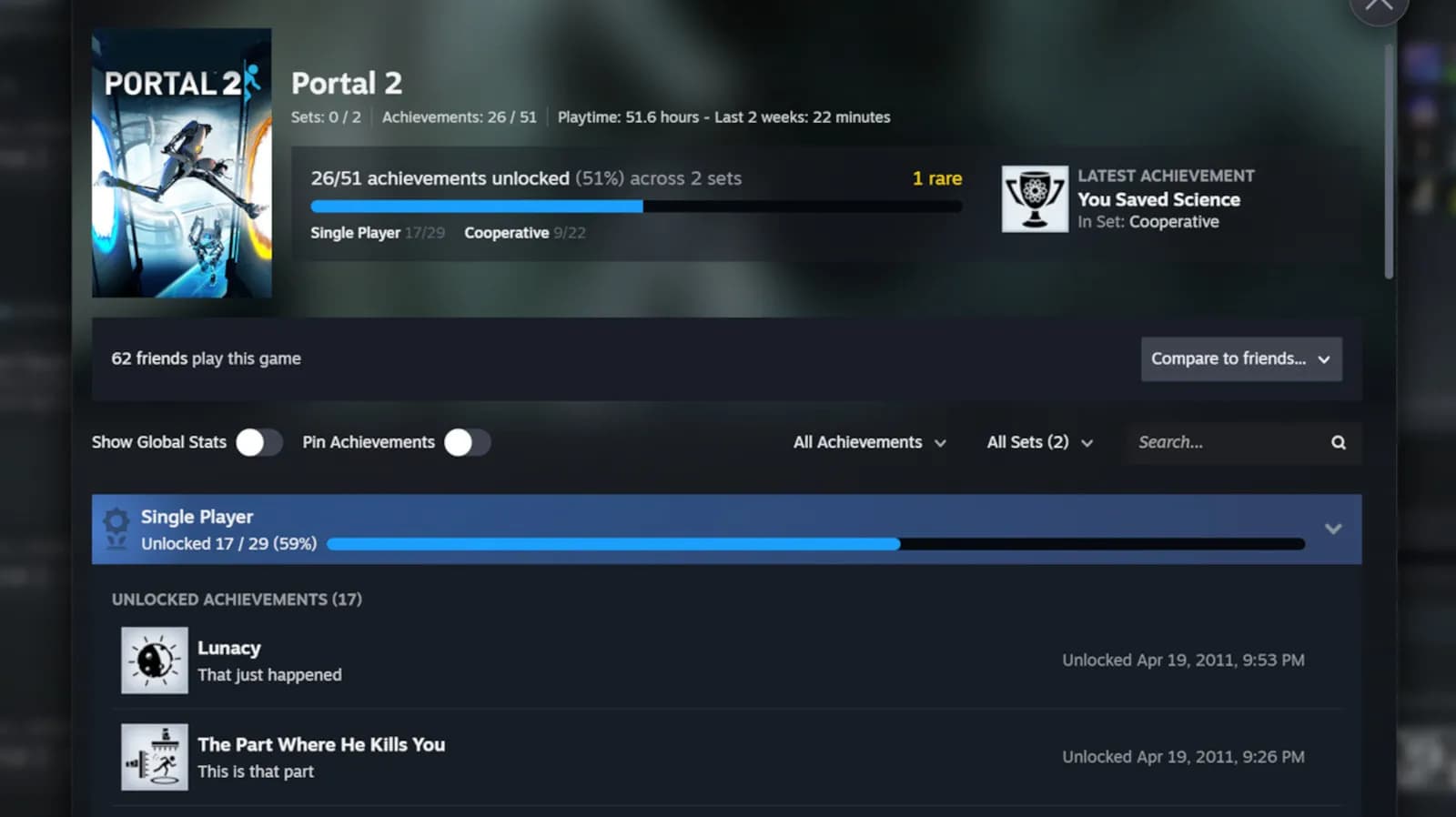
Valve is finally addressing this architectural limitation with the beta rollout of Achievement Sets. The newly revealed feature overhauls how achievements are grouped, calculated, and presented across game libraries and user profiles. By allowing studios to categorize milestones into discrete packages—separating the core release from subsequent episodic content, seasonal updates, or paid expansions—Steam is moving toward a more nuanced, modular model of player progression.
The Long-Standing Flaw in Monolithic Unlock Lists
To understand why this beta rollout is significant, it is necessary to examine how Steam traditionally managed achievement databases. Historically, every achievement associated with an application ID lived in a flat, collective pool. Whether an objective was tied to beating the opening tutorial or finishing an ultra-hard difficulty mode introduced in an expansion three years later, Steam's backend treated every entry as an equal contributor to the base percentage math.
This all-or-nothing system created perverse incentives for both players and game creators. Dedicated completionists frequently voiced exasperation when a surprise update or optional expansion stripped them of their perfect-game status, sometimes prompting negative reviews targeting post-launch content. For developers, this posed an awkward dilemma: either avoid adding new achievements in post-launch DLCs to prevent alienating dedicated fans, or release achievements anyway and deal with community pushback from players who did not want to buy an expansion just to regain their showcase status.
How Achievement Sets Segregate Base and Add-On Content
With Achievement Sets currently in testing, Valve is adopting a hierarchical structure that modernizes Steam’s telemetry and display systems. Under this new framework, achievements can be assigned to specific collections. The primary set reflects the core, launch-state experience, while ancillary sets represent independent DLC packs, content expansions, or seasonal campaigns.
Under this modular architecture, once a player conquers the base game’s checklist, their 100 percent completion badge is permanently acknowledged for that set. If an expansion arrives featuring dozens of additional tasks, it populates its own sub-tier rather than artificially diluting the completed primary tier. Players who own or engage with the new content can earn secondary badges or tier-specific distinctions, while those who only purchased the base game are not penalized for skipping optional expansions.
Closing the Competitive Gap with Console Platforms
While the feature arrives as a welcome relief to PC enthusiasts, it also highlights an area where Valve’s storefront had lagged behind its console counterparts. Sony introduced tiered trophy groups during the PlayStation 3 era, explicitly separating Platinum trophies—granted exclusively for mastering the base game—from subsequent DLC trophy lists. Similarly, Microsoft’s Xbox Live framework has long allowed developers to increment a game’s total Gamerscore with each add-on, letting players maintain proof of their original 1,000-point clear.
Steam’s historical reliance on simple total-count ratios meant that as live-service games and sprawling single-player RPGs continued to grow, the PC platform felt increasingly archaic. By implementing Achievement Sets, Valve is bringing its social infrastructure on par with established industry standards, eliminating platform-specific friction for multi-platform developers who previously had to restructure their reward systems specifically for Steam.
The Developer Experience and Steamworks Integration
From an engineering perspective, the update requires thoughtful consideration of the Steamworks API and backend management tools. Game developers configure achievements via Valve’s partner portal, tagging unlock criteria, localization strings, and icon assets. The rollout of sets suggests an updated schema that gives developers granular control over categorization and dependencies.
Crucially, backward compatibility remains an essential challenge for Valve. With tens of thousands of legacy titles populating the catalog, many of which are no longer actively maintained by their original creators, Valve must ensure that automated fallback mechanisms do not break older titles. Studios actively supporting live titles will likely need to opt in or manually reorganize their historical achievement pools to take full advantage of the segregation, while newly developed titles can build with modular sets in mind from day one.
Player Psychology and the Mechanics of Completionism
Beyond the technical mechanics, the launch of Achievement Sets acknowledges the potent psychological impact of completionist design. The desire to reach 100 percent is a primary driver of sustained player engagement, influencing purchasing habits, average playtime, and community guide generation. When digital achievements feel unstable or hostage to perpetual DLC updates, players experience completion fatigue and may disengage entirely.
By safeguarding a player's historical accomplishments, Valve restores a sense of agency and permanence to user achievements. It transforms post-launch expansions from an unwelcome chore that invalidates prior work into an inviting, self-contained challenge that can be approached on its own merits. This subtle psychological reset can improve long-term player sentiment, fostering a healthier lifecycle for long-supported games.
Looking Ahead: The Evolution of Steam’s Social Ecosystem
As the Achievement Sets feature progresses through its beta phase, user feedback will likely shape how progress is visually communicated across the Steam desktop client, the Steam Deck interface, and the web-based community hub. Valve will need to refine profile showcases, activity feeds, and comparative friends lists to elegantly display both base clears and modular DLC masteries without cluttering the interface.
Ultimately, this update marks an overdue but vital refinement of Steam's core platform features. By acknowledging the distinct separation between a game's foundation and its post-launch trajectory, Valve is resolving a decade-old pain point for completionists while providing developers with a cleaner, more flexible framework to support ongoing content without alienating their most dedicated fans.
Source: engadget.com