
Decoding the Physical Layer: Fiber vs. Cable Internet for Developers and Power Users

Introduction to Last-Mile Infrastructure
For modern software engineers, distributed systems architects, and remote-first technologists, the digital supply chain extends far beyond cloud-hosted microservices and edge compute nodes. It relies fundamentally on the last-mile physical infrastructure that bridges a residential or commercial workspace to the global backbone network. While much of our industry focuses on optimizing software layers—reducing payload sizes, implementing efficient serialization formats, and minimizing round-trip times in code—the hardware medium transporting those packets remains a critical bottleneck. Two primary technologies dominate this landscape for fixed-line broadband: traditional copper-based cable infrastructure and modern fiber-optic cabling.
Understanding the operational mechanics of fiber versus cable is more than a trivial networking exercise; it directly impacts daily workflows, from pushing gigabyte-scale Docker images to maintaining stable, low-latency SSH sessions and real-time video collaboration with distributed teams. Although both options promise high-speed broadband access, their underlying physics, signal attenuation characteristics, and scalability profiles diverge sharply. As data demands continue to surge with generative AI workloads, continuous integration pipelines, and heavy cloud synchronization, evaluating the limits of these two transmission mediums becomes essential for any technical professional.
The Architecture of Cable: Coaxial Copper and Hybrid Fiber-Coax
Traditional cable internet relies primarily on coaxial copper cables, a technology historically built for television broadcasting that was later adapted for bidirectional data transmission via the DOCSIS (Data Over Cable Service Interface Specification) standard. In a standard Hybrid Fiber-Coax (HFC) network, signals travel over fiber-optic cables from the Internet Service Provider's central facility to a neighborhood node, where they are converted into radio frequency (RF) signals and transmitted the rest of the way to a premises via copper coaxial wiring. Copper inherently possesses physical limitations regarding frequency response and electromagnetic interference, meaning that signal degradation occurs more rapidly over distance compared to optical alternatives.
From a performance perspective, the most prominent architectural constraint of legacy cable networks is their asymmetry. Cable operators designed HFC systems to allocate vastly more bandwidth to download streams than to upload streams, reflecting legacy consumer habits where users primarily consumed web content rather than generating it. While modern DOCSIS iterations have introduced channel bonding and advanced modulation schemes to push download speeds well into the gigabit range, upload speeds frequently lag significantly behind. For software developers, video creators, and anyone routinely uploading large artifacts to cloud repositories, this upstream asymmetry can create a noticeable operational bottleneck.
The Mechanics of Fiber Optics: Total Internal Reflection and Photons
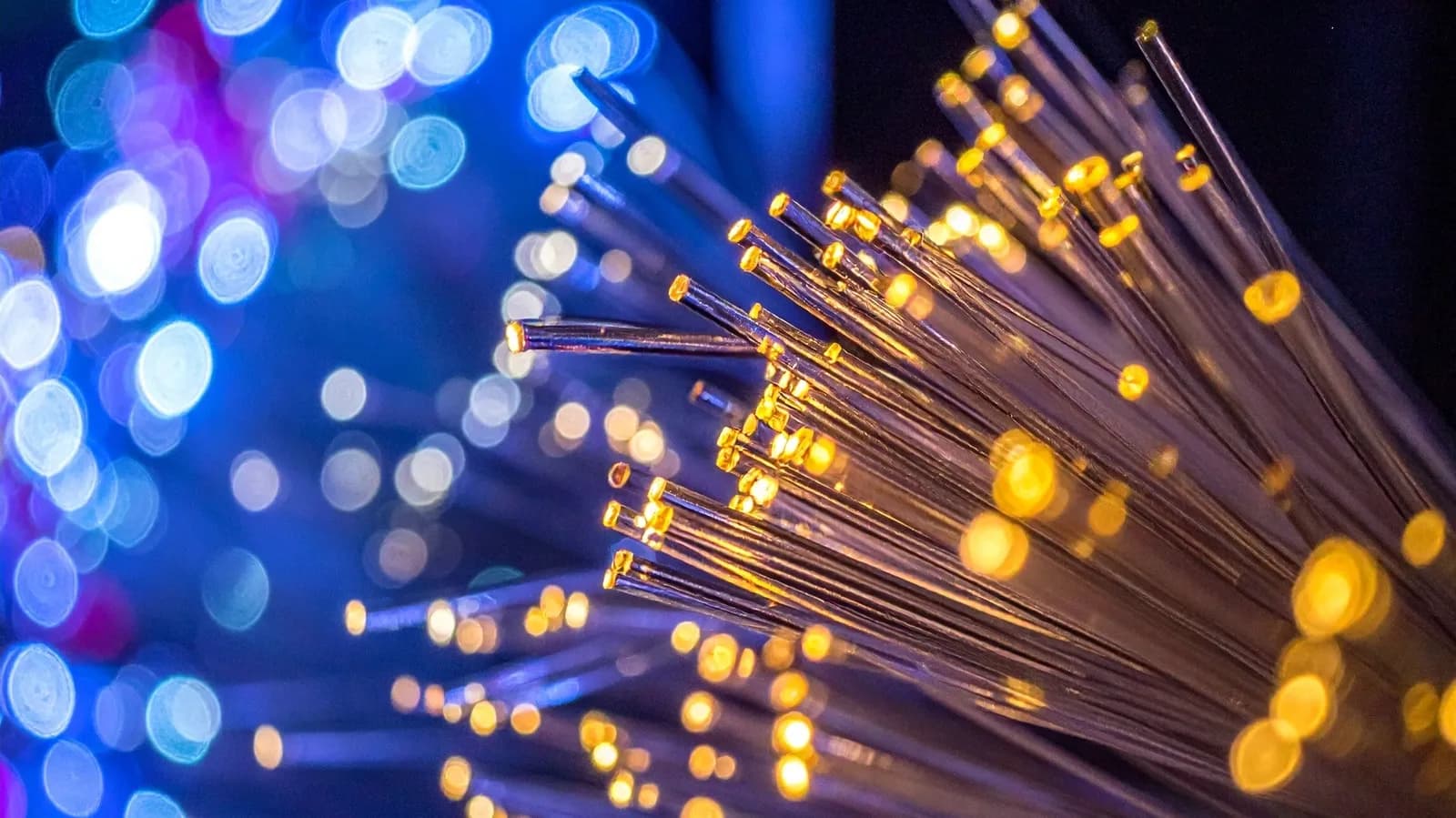
Fiber-optic internet replaces copper entirely with strands of ultra-pure glass or plastic designed to transmit data as pulses of light rather than electrical currents. Operating on the principle of total internal reflection, light signals bounce down the core of the fiber optic strand without escaping, experiencing virtually no degradation over long distances. This fundamental shift from electrons to photons removes the electrical resistance, crosstalk, and susceptibility to electromagnetic interference that plague copper wiring, allowing for vastly higher data-carrying capacities across extended physical spans.
The operational benefits of pure fiber infrastructure manifest most clearly in symmetric bandwidth availability and exceptional latency profiles. Because light can travel simultaneously in both directions without electrical interference, fiber-to-the-home (FTTH) architectures routinely deliver equal upload and download speeds, transforming consumer connections into enterprise-grade pipes. For developers pushing large codebases, managing multi-gigabyte database dumps, or provisioning cloud infrastructure, symmetrical bandwidth eliminates the wait times traditionally associated with pushing heavy assets back to remote servers or artifact registries.
Comparing Throughput, Latency, and Reliability Metrics
When evaluating network performance for demanding technical applications, three core metrics dictate the user experience: throughput, latency, and packet loss reliability. While high-tier cable packages can technically match fiber on peak download bandwidth, they often stumble under sustained loads and concurrent usage. Cable networks operate on a shared medium architecture within neighborhoods, meaning that local network congestion during peak evening hours can introduce micro-jitters, latency spikes, and degraded throughput for individual users sharing the same local loop.
Latency—the time it takes for a packet of data to travel from source to destination—is another domain where fiber holds a distinct structural advantage. Light travels faster through a glass fiber core than electricity does through copper, and the absence of signal amplification requirements over short runs keeps propagation delays to an absolute minimum. Lower latency translates directly to a snappier remote desktop experience, faster container orchestration responses, and more reliable real-time communication. Furthermore, fiber’s resistance to environmental factors like moisture, temperature fluctuations, and nearby power lines ensures a significantly higher degree of uptime and packet delivery consistency.
Developer and Power User Impact: Why the Medium Matters
For the average consumer, the difference between a cable connection and a fiber connection might boil down to how quickly a streaming movie buffers or how smoothly a web page renders. For developers and technical power users, however, the choice of network medium profoundly affects productivity and workflow architecture. Working with cloud-native development environments, managing Kubernetes clusters, and streaming continuous logs from remote servers require a robust, bidirectional data pipe that does not buckle under heavy burst traffic or prolonged upstream strain.
Consider the daily routine of a modern engineer: pulling container images, syncing local databases with cloud replicas, pushing continuous integration triggers, and participating in high-definition code reviews. An asymmetrical cable connection can stall upload queues when multiple developer tools contend for limited upstream bandwidth. Fiber eliminates these friction points, ensuring that developer tooling operates with local-network-like responsiveness even when interacting with distant cloud regions. It changes the calculus of remote work, making geographical location less of a constraint on technical capability.
The Rollout Realities and Future-Proofing the Grid
Despite the clear technical superiority of fiber-optic infrastructure, its widespread adoption faces significant economic and logistical hurdles. Deploying fiber requires trenching streets, stringing aerial cables, and overhauling legacy last-mile infrastructure, a capital-intensive process that telecommunications providers roll out gradually, often prioritizing dense urban centers over rural or suburban areas. Consequently, millions of households and small offices remain tethered to legacy cable networks simply due to geographic availability rather than technological preference.
Nevertheless, cable operators are not standing still. Continuous evolution within the DOCSIS specification aims to squeeze more performance out of existing copper footprints through spectrum expansion and full-duplex transmission techniques. Yet, these incremental upgrades are ultimately bridging a widening gap rather than surpassing optical capabilities. As data consumption scales exponentially alongside artificial intelligence training workflows, remote rendering, and ubiquitous cloud computing, fiber-optic networks represent the definitive future-proof foundation for digital connectivity.
Conclusion
While traditional cable internet remains a capable and ubiquitous technology that satisfies the baseline needs of many modern users, it is fundamentally bounded by the physical limitations of copper wiring and asymmetrical design paradigms. Fiber-optic infrastructure represents a generational leap forward, leveraging the physics of light to deliver symmetrical multi-gigabit throughput, ultra-low latency, and superior reliability. For developers and technical professionals whose daily workflows depend heavily on robust, high-performance network access, choosing fiber whenever available is not just an upgrade in speed—it is a critical investment in operational efficiency.
Source: engadget.com