
Meta Unveils AI-Driven Edits Assistant to Boost Creator Workflows on Instagram

The Next Evolution of Creator Tools
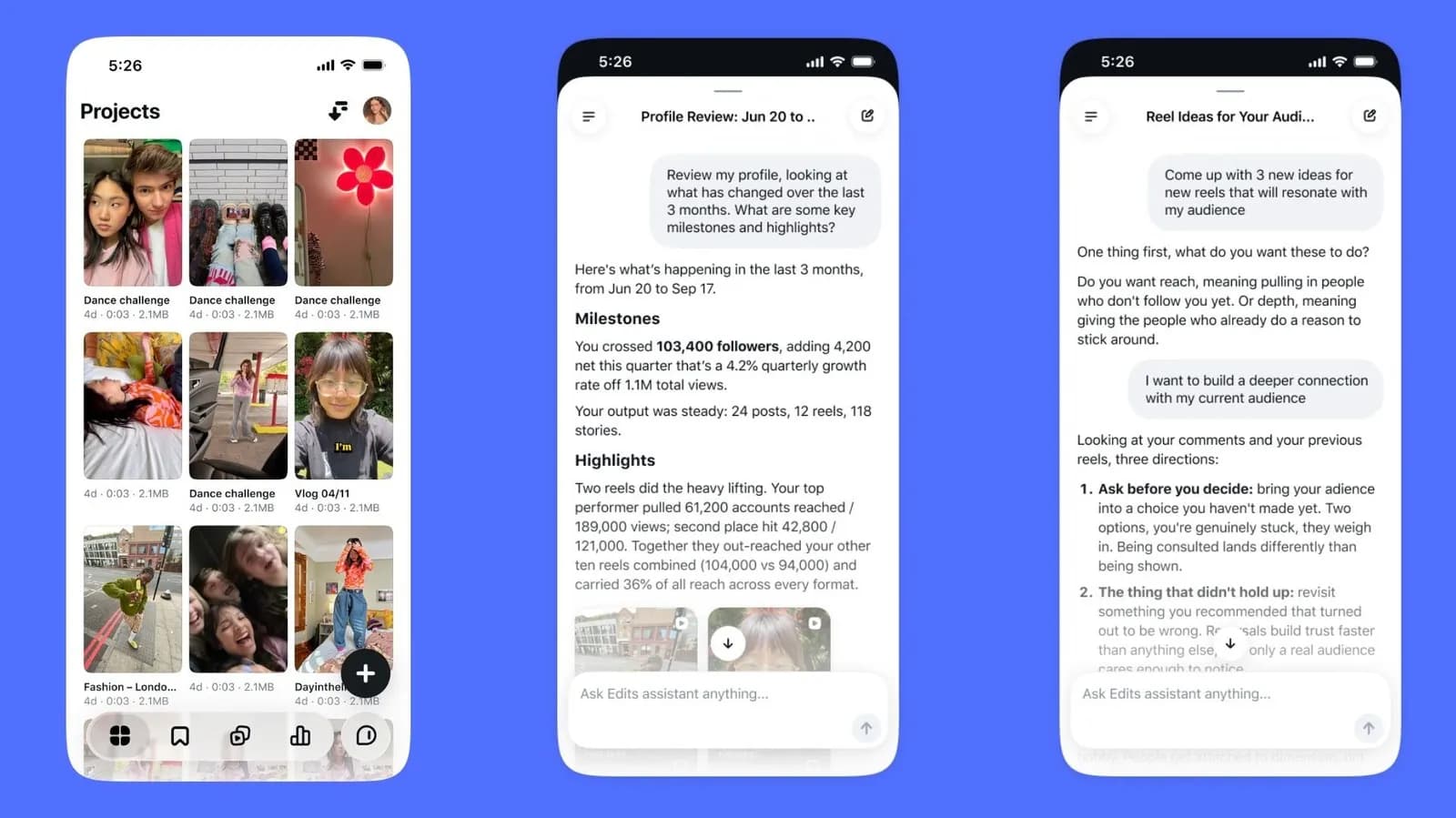
In the fiercely competitive landscape of short-form video and algorithmic feeds, social platforms are constantly seeking new ways to keep their most prolific creators engaged and productive. Meta has taken its latest step in this direction by launching an AI-powered editing and strategy assistant designed specifically for Instagram creators. Known as the Edits assistant, the new tool is engineered to analyze a creator's existing catalog, evaluate historical engagement trends, and deliver tailored recommendations designed to optimize reach and audience retention.
Rather than functioning merely as an automated video splicing utility or an open-ended chatbot, the Edits assistant bridges the gap between raw data analytics and creative execution. By interpreting performance telemetry directly within the app, the assistant attempts to demystify platform mechanics for creators who may lack dedicated marketing or production teams. This release reflects Meta’s broader strategic mandate: embedding intelligent agentic layers into consumer and business interfaces to make its software ecosystem indispensable.
How the Edits Assistant Operates
At its core, the Edits assistant operates by ingesting audience signals alongside metrics derived from a creator's best-performing posts. It reviews attributes such as watch time, drop-off rates, visual pacing, caption effectiveness, and comment sentiment to suggest actionable changes for upcoming projects. Creators can receive contextual advice regarding optimal clip durations, narrative hooks, and stylistic formats that resonate most strongly with their specific demographic segments.
This personalized approach distinguishes the tool from generic generative AI prompts. While standard large language models can draft generic scripts or suggest broad social media themes, they generally lack direct access to a creator's internal performance dashboard. By grounding its reasoning in actual user telemetry, Meta’s assistant delivers highly contextualized guidance, effectively serving as an on-demand creative strategist embedded directly within the editing interface.
The Architecture Behind Content-Aware AI Guidance
From an engineering and systems design perspective, building an assistant of this caliber requires the convergence of several complex technologies. A primary challenge in developing content-aware assistants is real-time multimodal analysis combined with structured retrieval-augmented generation (RAG). The system must process video and audio streams to understand pacing and tone, while simultaneously querying analytical databases to evaluate historical key performance indicators (KPIs).
Meta likely leverages distilled variants of its open-weight Llama family alongside specialized fine-tuned models trained on social media performance metrics. The underlying architecture must maintain strict privacy barriers, ensuring that proprietary analytics from one creator inform recommendations without leaking sensitive account telemetry across the multi-tenant platform. By executing fast inferencing pipelines that translate statistical insights into natural language suggestions, Meta turns opaque algorithmic feedback into digestible creative advice.
Implications for the Creator Economy and Developers
For independent software developers and third-party SaaS vendors operating in the social media management space, Meta's native solution signals significant shifts. Tools that historically offered third-party scheduling, basic analytics dashboards, or generic AI copywriting now face steep competition from vertically integrated platform features. When a host platform can natively combine telemetry with proactive generative agents, external utilities must either pivot toward deeper enterprise functionality or integrate more closely with platform APIs.
Furthermore, the arrival of in-app AI advisory systems suggests a future where software development kits (SDKs) and creator APIs may expand beyond static data endpoints. Developers building video editing software, digital asset managers, and creator-focused CRM platforms will increasingly need to support dynamic, AI-to-AI handoffs. If platform assistants can define what content formats perform best, external production suites will need to automate the assembly of those formats programmatically.
Algorithmic Homogenization and Potential Platform Risks
Despite the operational advantages offered by personalized AI guidance, the introduction of automated strategic advice raises critical questions about platform diversity and creative originality. If millions of creators receive optimization suggestions derived from the same underlying analytical models, feeds run the risk of accelerating toward structural homogenization. Creators could end up producing increasingly formulaic content optimized purely to satisfy algorithmic retention metrics rather than artistic novelty.
There is also the challenge of model hallucination and flawed causal inference. Content performance on modern recommendation feeds is influenced by a complex web of external trends, real-world events, and network effects. If an AI assistant correlates high engagement with superficial editing choices—such as a specific cut cadence or text overlay—creators might invest time in optimizations that have little bearing on actual viewer satisfaction. Balancing algorithmic optimization with genuine human creativity remains an unresolved tension in platform design.
What Lies Ahead for Meta's In-App Intelligence
Looking forward, the launch of the Edits assistant represents only the initial phase of Meta’s agentic roadmap across its family of apps. As multimodal models become faster and more cost-effective to run at scale, we can anticipate these assistants moving from passive advisory roles to active co-creation. In future iterations, creators might simply instruct an assistant to adjust aspect ratios, auto-generate localized audio tracks, or refactor pacing across multiple aspect ratios automatically based on real-time feedback.
By directly integrating machine intelligence into the production loop, Meta is strengthening its moat against rival platforms like TikTok and YouTube. For creators and software engineers alike, the Edits assistant underscores a broader industry reality: data analytics is evolving from static retrospective reports into real-time, interactive agents capable of shaping the creative process itself.
Source: engadget.com