
Microsoft's Surface Laptop Ultra Embraces High-End Graphics to Redefine Mobile Performance

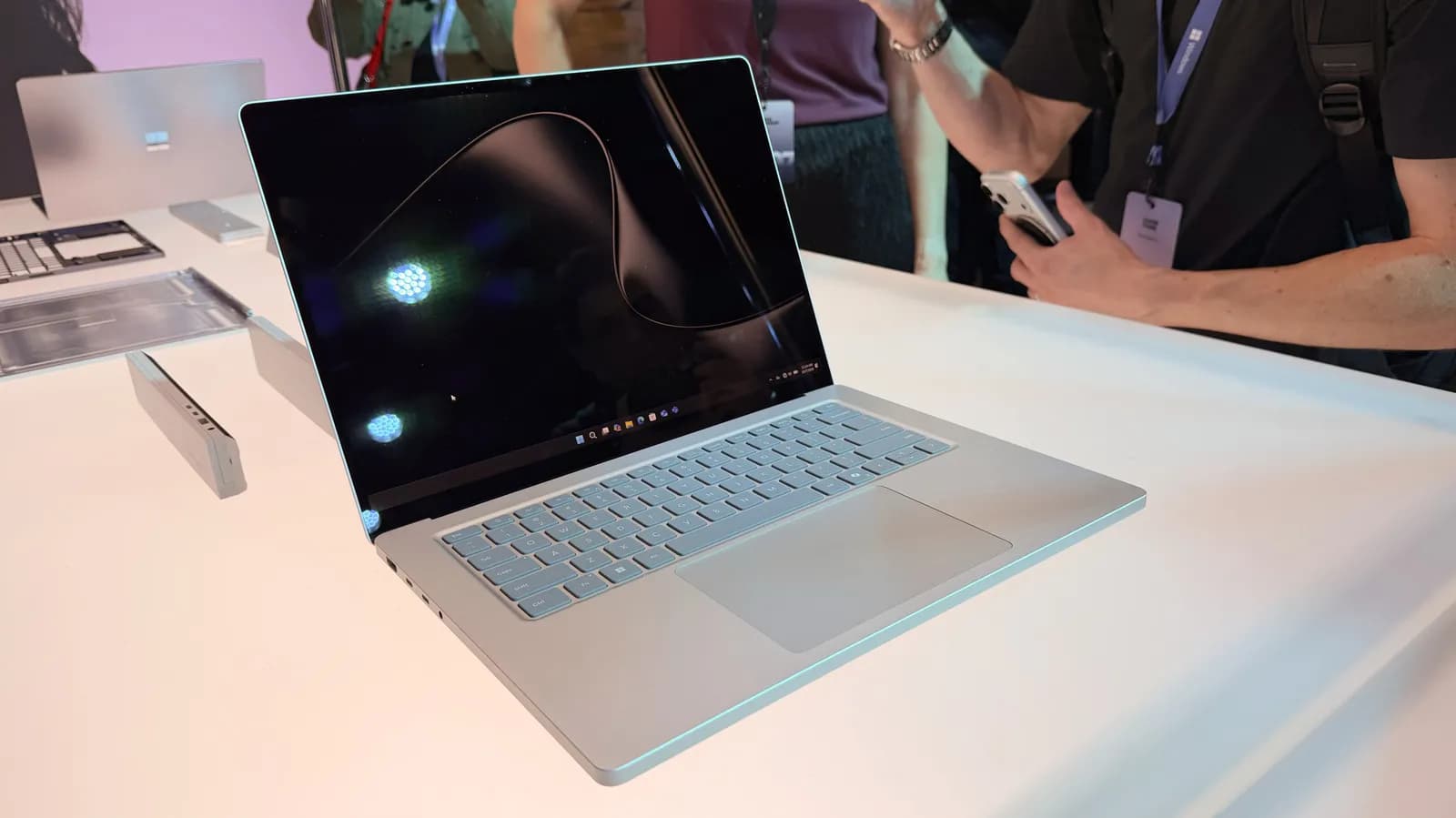
In an era where the boundary between enterprise desktop workstations and ultraportable notebooks has grown increasingly blurred, hardware manufacturers face a difficult balancing act. Users demand the svelte form factors and refined materials that modern industrial design affords, yet creative and engineering workflows require more silicon horsepower than ever before. With early looks at the Surface Laptop Ultra, Microsoft appears intent on proving that sleek aesthetics do not need to come at the expense of serious computational muscle, especially when backed by dedicated NVIDIA RTX graphics hardware.
While consumer-oriented ultraportables frequently trade away sustained throughput in the name of chassis thinness and quiet operation, workstation-grade portables have historically tended toward bulky designs, heavy power bricks, and aggressive cooling vents. The arrival of machines like the Surface Laptop Ultra highlights an evolving product tier: laptops engineered to provide engineers, machine learning practitioners, and creative professionals with true high-performance computing without abandoning the premium look and feel of a flagship consumer device.
A New Paradigm for High-Performance Portables
For several generations, the premium PC landscape was divided cleanly into two camps. On one side stood the ultra-thin productivity notebooks, celebrated for long battery life, pristine displays, and lightweight builds, but fundamentally bottlenecked by integrated graphics and restricted thermal envelopes. On the other side were the mobile workstations and gaming rigs—machines capable of handling complex simulation pipelines, 3D rendering, and local neural network inference, but carrying significant mass and compromised battery endurance.
The emergence of designs like the Surface Laptop Ultra signals that this dichotomy is rapidly dissolving. By pairing cutting-edge manufacturing techniques with high-efficiency mobile graphics architectures such as NVIDIA's RTX silicon, hardware designers can now disperse heat more effectively through vapor chambers and custom heat-pipe arrays. As a result, users are no longer forced to pick between a machine that fits gracefully into an executive boardroom and one capable of compiling complex codebases and training localized models.
For Microsoft, expanding the Surface lineage in this direction represents a strategic maturation of its hardware philosophy. Rather than simply serving as showcase reference hardware for Windows, these ultra-tier devices are positioned directly against top-tier workstation portables, offering a clean, unified platform designed from chassis to operating system for demanding power users.
Under the Hood: Balancing Raw Power and Thermal Limits
Engineering a slim chassis to accommodate dedicated, discrete GPU silicon requires overcoming severe thermodynamic constraints. Silicon that draws significant wattage under sustained load generates concentrated thermal energy that must be moved away from the core components without turning the laptop surface uncomfortably warm or driving the acoustic profile to jet-engine levels. In compact hardware, thermal throttling remains the primary enemy of performance consistency.
Modern GPU architectures have addressed this dilemma by shifting toward intelligent dynamic power sharing, multi-phase power delivery, and specialized acceleration cores. By delegating specific tasks—such as matrix multiplications, ray tracing calculations, or media encoding—to specialized hardware units on the GPU die, modern chips can complete complex workloads in shorter bursts at higher efficiency. This architecture minimizes sustained thermal accumulation, enabling slim devices to deliver performance spikes that rival previous-generation desktop setups.
Nevertheless, thermal design remains an engineering compromise. Even the most sophisticated chassis architecture must contend with the laws of physics. Users evaluating devices of this pedigree must consider whether sustained workloads, such as marathon 3D renders or prolonged batch data processing, will trigger performance throttling over extended sessions, or whether the device maintains the thermal headroom required for consistent, uncompromised compute throughput.
The Developer Perspective: Local Compute Meets Modern Toolchains
For software developers, the value proposition of a machine with dedicated RTX silicon extends far beyond graphics fidelity. Contemporary software development has become remarkably compute-intensive. Compiling large-scale projects, running local container clusters, orchestrating microservice topologies, and executing automated test suites concurrently require robust multi-core CPU architectures and expansive memory bandwidth. When local AI development enters the equation, dedicated GPU compute becomes practically indispensable.
The rise of localized generative AI, on-device large language model (LLM) fine-tuning, and edge inferencing has revolutionized developer requirements. Engineers working on artificial intelligence pipelines increasingly rely on local hardware for rapid prototyping and validation before deploying workloads to expensive cloud clusters. Having hardware capable of executing quantized models, managing tensor math, and leveraging CUDA-accelerated libraries directly on a portable machine drastically tightens the feedback loop, saving both cloud expenditure and operational latency.
Furthermore, developers building rich multimedia applications, spatial computing experiences, or game engines benefit immediately from integrated RTX hardware. Being able to inspect shaders, compile graphical pipelines, and preview ray-traced lighting models in real-time on a laptop that fits easily into a backpack unlocks a level of developer mobility that was unimaginable just a few years ago.
Software Ecosystem and AI Acceleration on the Go
Hardware capabilities are only as effective as the underlying software layer designed to harness them. Over recent years, both Microsoft and NVIDIA have invested heavily in bridging developer toolchains with native hardware accelerators. Through initiatives focused on Windows on-device AI integration, optimized drivers, and specialized SDKs, modern development stacks can offload compute workloads seamlessly to dedicated hardware execution units.
This synergy is particularly visible across creative software suites, computer vision frameworks, and data science workflows. Modern operating systems are increasingly engineered to offload background tasks, audio-video processing, and contextual intelligence to specialized silicon blocks, freeing the primary CPU and GPU cores to prioritize intensive developer processes. When combined with mature graphics compute backends, the overall platform efficiency scales significantly beyond raw clock speed metrics.
For teams building cross-platform solutions, having access to high-performance local environments ensures parity between production environments and developer machines. Testing graphics pipelines, compiling native modules, and profiling memory management on high-bandwidth architectures reduces deployment surprises when software transitions to production environments.
The Trade-Offs: Battery Life, Ergonomics, and Premium Pricing
Despite the undeniable appeal of a gorgeous, high-powered laptop, such engineering marvels rarely come without practical trade-offs. The first and most persistent challenge is battery life. While modern silicon incorporates granular power-gating states to preserve power during lightweight productivity tasks, invoking dedicated graphics cores rapidly depletes standard lithium-ion batteries. Users requiring all-day computing away from a power outlet often find themselves needing to carry specialized high-wattage power supplies or accepting throttled performance profiles while on battery power.
Ergonomics and serviceability also present significant challenges. Ultra-dense internal configurations often necessitate soldered memory, tightly integrated system-on-chip components, and limited physical upgrade paths. When consumers invest heavily in high-end configurations, the inability to replace internal storage, upgrade RAM modules, or easily service cooling fans over time can shorten the operational lifespan of the hardware relative to its initial capital cost.
Finally, price remains a substantial barrier to entry. Machined metal unibodies, advanced displays, bespoke thermal engineering, and top-tier GPU silicon combine to position these devices well into the upper tier of personal computer pricing. For enterprise procurement departments and independent developers alike, justifying this investment requires a clear assessment of whether the portable compute density translates directly into measurable productivity gains.
Looking Ahead: The Evolving Workstation Landscape
The trajectory established by devices like the Surface Laptop Ultra reflects where personal computing hardware is heading over the next decade. As high-density silicon manufacturing matures and power efficiencies improve, the need for sprawling, noisy desktop towers will continue to recede into niche industrial applications. The laptop is solidifying its position as the primary command center for software engineers, digital artists, and systems architects.
Competition across this segment is intensifying dramatically. Between the rapid maturation of alternative system architectures, continuous leaps in integrated graphic capabilities, and dedicated accelerators woven throughout modern chips, users have more high-performance portable options than at any point in computing history. Devices that stand out in this crowded market will be those that achieve harmony between raw numerical capability, sustained thermal equilibrium, and uncompromising industrial ergonomics.
Ultimately, the Surface Laptop Ultra stands as a testament to the fact that modern workstation performance no longer requires aesthetic austerity. For professionals who demand uncompromised graphics capabilities, local artificial intelligence acceleration, and refined portability in a single machine, this emerging breed of laptops represents a compelling glimpse into the future of professional mobile computing.
Source: engadget.com