
Microsoft Surface Laptop Ultra Review: Can One Machine Truly Handle Dev, AI, and Gaming?

The Elusive Dream of the Universal Machine
For more than a decade, power users and software developers have lived with an unspoken compromise. If you wanted portability and stellar battery life, you opted for an ultrabook. If you needed heavy-duty compile power, complex virtual machine clusters, and modern gaming performance, you either chained yourself to a bulky desktop tower or endured a thick, noisy mobile workstation whose battery depleted in less than two hours. The arrival of local artificial intelligence workloads has only exacerbated this divide, demanding sustained neural processing throughput, abundant memory bandwidth, and high-performance silicon all at once.
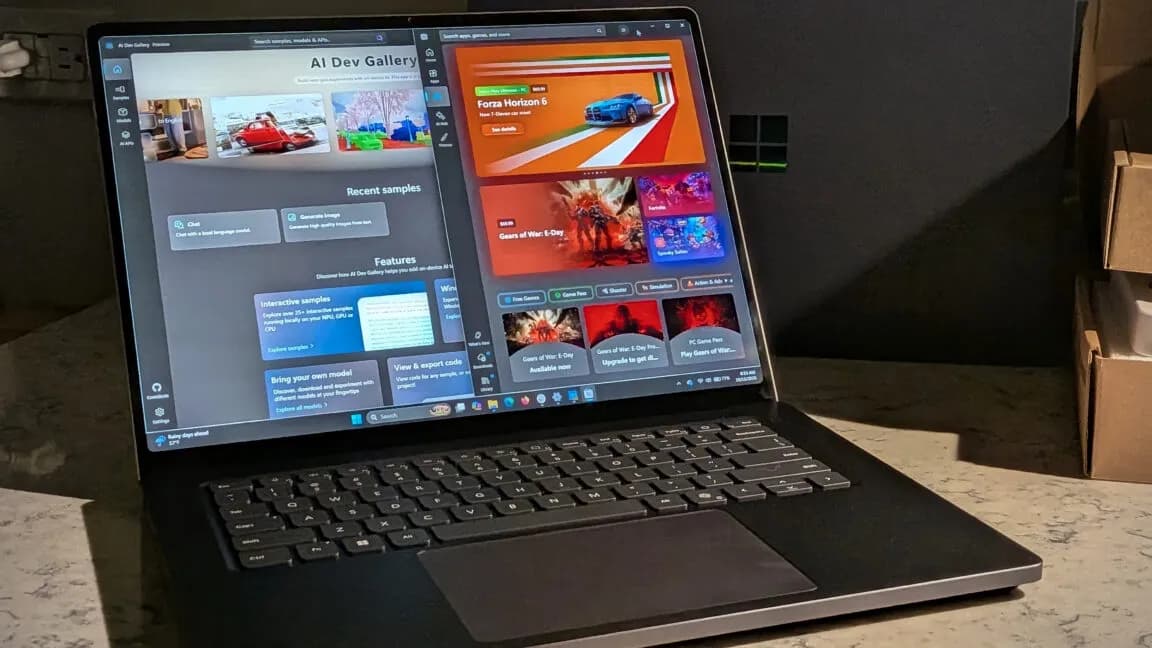
Microsoft has stepped into this technical crossfire with the Surface Laptop Ultra, a device engineered to bridge these historically incompatible worlds. Pitched as a singular solution capable of tackling demanding software engineering, on-device AI model execution, and top-tier PC gaming without forcing radical ergonomic trade-offs, the machine sets an extraordinarily high bar for itself. While achieving absolute perfection across such divergent computing tasks is near impossible, Microsoft has delivered a flagship device that gets closer to that universal ideal than almost anything before it.
Bridging Software Engineering and Heavy Graphics
Software development has evolved dramatically in recent years. Modern engineers are no longer just editing text and running modest test suites; modern stacks routinely involve containerization via Docker, running multiple virtualization layers, compiling massive codebases, and managing heavy background language servers. Layering modern graphics rendering or game engine development like Unreal Engine on top of that workload immediately exposes the memory bottlenecks and thermal throttling inherent in conventional ultraportable laptops.
The Surface Laptop Ultra addresses these pain points by balancing dense multicore central processing power with a dedicated graphics pipeline. By giving developers immediate access to high-performance compute silicon without requiring constant remote offloading to cloud servers, the machine fundamentally accelerates iterative feedback loops. Code compilation times remain swift under sustained pressure, and the machine handles deep dependency trees and local microservice meshes without the immediate system stutter that plagues lighter hardware.
The Growing Necessity of Local AI Workloads
Perhaps the most significant differentiator in this generation of premium hardware is the pivot toward local artificial intelligence execution. While commercial large language models remain heavily reliant on massive hyperscale data centers, developers are increasingly looking to run quantized models, code completion engines, and specialized neural networks entirely on local hardware. The motivations are clear: reduced latency, zero API token costs, improved privacy, and the ability to work completely offline.
Equipped with specialized neural processing capabilities alongside discrete graphics acceleration, the Surface Laptop Ultra is designed to make local model hosting a practical daily reality. Running multi-billion parameter models locally requires both raw floating-point performance and substantial unified memory capacity. By optimizing data paths between the processor, graphics cores, and system memory, the machine enables responsive inference for developer assistants and multimodal workflows, proving that edge computing is finally ready for professional creative pipelines.
Gaming Performance as an Engineering Benchmark
While productivity and code execution are primary concerns for developers, gaming performance serves as a rigorous proxy for real-world graphical and thermal limits. Modern interactive titles stress every component of a computer simultaneously, requiring rapid texture streaming, sustained high clock frequencies, and continuous thermal dissipation over hours of continuous operation. Historically, workstation-class machines faltered when handling consumer gaming engines due to driver mismatches or thermal throttling designed solely for bursty office tasks.
The Surface Laptop Ultra avoids this pitfall by treating gaming not as an afterthought, but as a core architectural validation point. Titles leveraging modern rendering pipelines, hardware-accelerated ray tracing, and resolution scaling run smoothly, confirming that the machine's thermal management can sustain prolonged peak power draw. For developers working within game engines or simulation software, this graphical competence ensures that asset previewing and real-time environment testing occur in genuine high-fidelity environments without requiring a secondary desktop test rig.
The Inevitable Trade-offs: Heat, Weight, and Portability
Despite its impressive versatility, the laws of thermodynamics cannot be completely rewritten. Jamming enterprise-grade compute, local AI accelerators, and high-performance gaming silicon into a refined, portable chassis inevitably forces real-world trade-offs. Under full synthetic load—or during simultaneous model fine-tuning and compilation—the cooling fans make their presence distinctly known, spooling up to push considerable heat away from the internal components.
Battery longevity also presents a classic dual-mode reality. When performing standard developer tasks like editing code in a lightweight environment, browsing technical documentation, and handling communications, the laptop can comfortably carry users through a normal workday. However, the moment discrete compute silicon engages for sustained rendering, local model inference, or gaming sessions, battery percentage drops at an accelerated rate. Power users must remain mindful that peak performance still fundamentally demands access to a wall outlet.
Strategic Implications for the Hardware Ecosystem
Microsoft's push with the Surface Laptop Ultra sends a clear message across the PC hardware ecosystem: the era of single-purpose professional hardware is ending. As artificial intelligence becomes an embedded layer across development tools, productivity suites, and creative software, hardware manufacturers must adapt by providing balanced silicon architectures capable of handling heterogeneous compute loads out of the box.
This release also pressures competing hardware vendors to rethink how they segment their product portfolios. For years, the market has forced buyers to choose between thin-and-light productivity machines, garish gaming laptops, or unwieldy industrial workstations. By delivering a clean, professional aesthetic wrapped around hardware robust enough for codebases, local neural networks, and modern 3D titles, Microsoft is carving out an expansive hybrid category that developers and creative technologists have requested for years.
The Verdict: An Ambitious Machine for Demanding Workflows
The Surface Laptop Ultra does not entirely eliminate the physical limitations of mobile computing, but it narrows the gap between specialized workstations and portable laptops to an unprecedented degree. By effectively handling the trinity of modern power computing—intricate development environments, on-device AI exploration, and high-end interactive entertainment—it delivers on the vast majority of its promises.
For software engineers, technical creators, and users who demand absolute flexibility from a single portable machine, the investment represents a compelling, future-facing proposition. It may not replace a dedicated server farm or a liquid-cooled desktop for extreme high-end compute, but as an all-in-one daily driver, the Surface Laptop Ultra successfully redefines what a versatile mobile workstation can achieve.
Source: arstechnica.com