
Securing Your Prompts: Why OpenAI's PIN-Lock Feature Matters for Developer Privacy

Introduction to Client-Side Privacy Controls
As artificial intelligence assistants become deeply integrated into our daily workflows, the nature of the data we share with them has fundamentally shifted. Software engineers, security researchers, and data scientists routinely paste code snippets containing internal API keys, database connection strings, proprietary architecture blueprints, and confidential logic into chat interfaces like ChatGPT. While conversational AI has supercharged developer productivity, it has simultaneously introduced unprecedented attack vectors regarding data exposure and privacy.
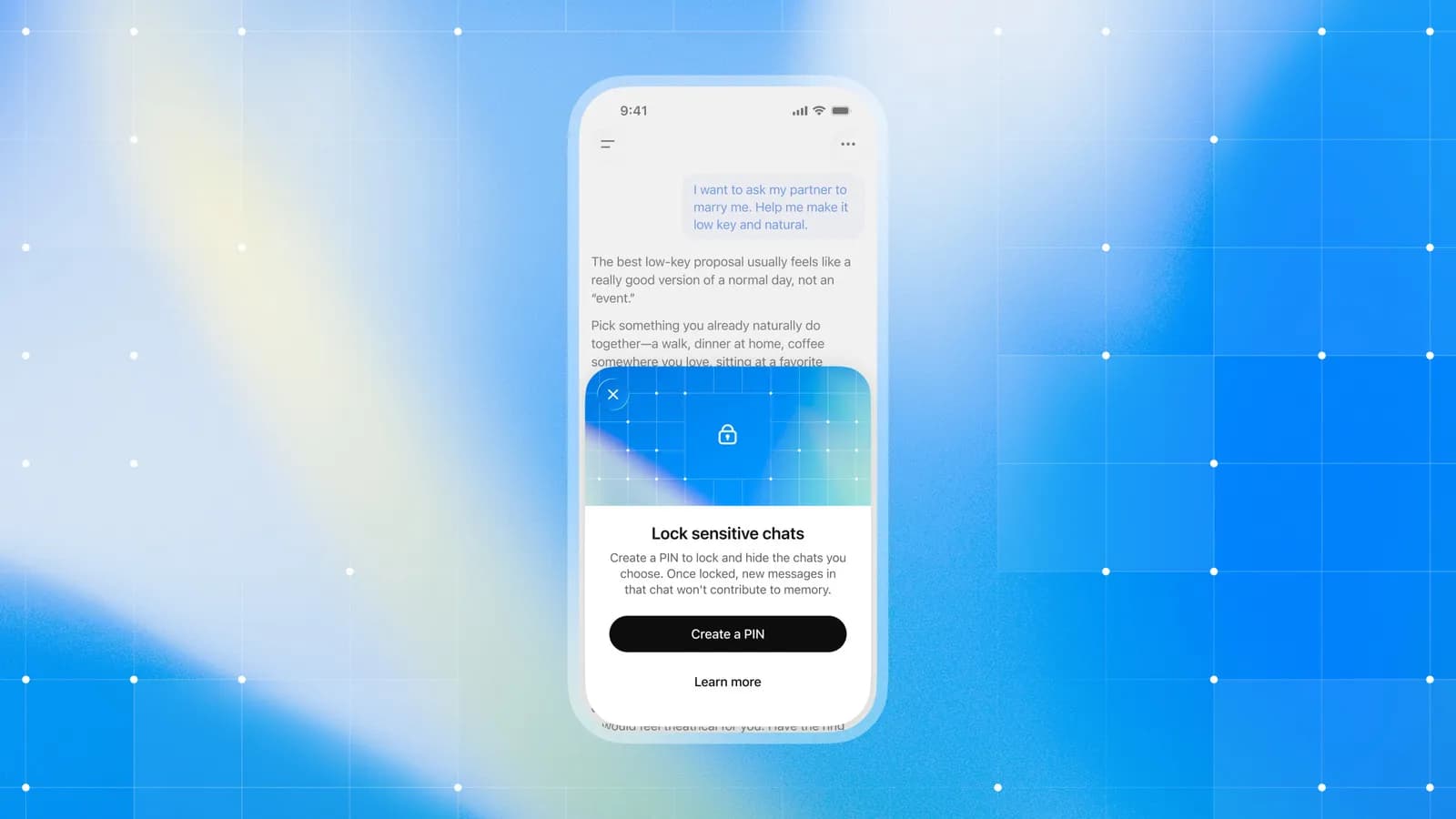
Recognizing the mounting anxiety around accidental screen sharing, shared office workstations, and unauthorized device access, OpenAI has introduced a long-overdue security mechanism: the ability to lock sensitive chats behind a PIN. This feature shifts a portion of the security paradigm from purely server-side data governance to immediate, device-level user control. For developers who use AI tools as cognitive extensions of their daily work, this update represents a vital incremental step toward managing sensitive intellectual property within consumer-grade AI applications.
The Mechanics of Chat Locking
At its core, the new chat-locking functionality is designed to prevent casual snooping or unauthorized access when a device is left unattended. When a user designates a specific conversation as sensitive, that thread is walled off behind an authentication barrier—typically requiring a PIN or biometric confirmation such as FaceID or fingerprint scanning depending on the host device. This ensures that even if someone gains unlocked access to the main application interface, designated high-security threads remain obfuscated.
Unlike enterprise-tier deployments that rely on strict data-retention opt-outs and zero-logging agreements, this feature operates closer to the user experience layer. It functions similarly to secure folder applications or encrypted messaging platforms that hide preview snippets of incoming notifications. By addressing the physical security gap—the literal screen sitting on a desk or a laptop left open in a coffee shop—OpenAI is mitigating one of the most common vectors of accidental data leakage.
Why This Matters for Software Engineers
For the engineering community, privacy has always been a paramount concern. When writing code, debugging legacy systems, or refactoring microservices, developers frequently encounter edge cases that require pasting snippets of production code into an LLM. Even with enterprise privacy guarantees promising that inputs will not be used for model training, the mere existence of persistent chat histories poses a risk if a third party gains access to the user's account dashboard.
The ability to lock specific chats means developers can compartmentalize their interactions. A casual prompt about sorting algorithms can live alongside un-locked general history, while a deep dive into patching a critical zero-day vulnerability or analyzing proprietary internal architecture can be instantly siloed behind a strict security barrier. This granular control reduces the cognitive friction of trying to remember to manually delete sensitive threads immediately after a debugging session concludes.
The Balance Between Convenience and Security
Security implementations invariably introduce usability trade-offs, and client-side chat locking is no exception. Requiring a secondary authentication step for individual threads can disrupt the rapid, fluid cadence of a heavy coding or writing session. Developers value velocity, and any friction that requires context-switching—such as entering a PIN repeatedly throughout the day—threatens to slow down the iterative feedback loop that makes AI tooling so addictive.
However, the industry has largely accepted that convenience must yield to security when handling sensitive data. The introduction of biometric integration largely mitigates this friction, allowing developers to unlock chats seamlessly via a glance or a touch rather than typing a multi-digit numeric code. Balancing this seamless user experience with robust cryptographic separation of chat threads will be critical as platform features continue to evolve.
Broader Industry Implications for AI Platforms
OpenAI's introduction of PIN-locked chats sets a new baseline expectation for consumer and prosumer AI interfaces. Historically, AI vendors competed primarily on parameter count, reasoning benchmarks, and context window length. Today, privacy features and data control mechanisms are rapidly becoming major competitive differentiators. Competitors in the generative AI space will inevitably be forced to adopt similar client-side security measures to match user expectations.
Furthermore, this move aligns with tightening global regulatory standards regarding data minimization and user-controlled privacy. By giving individuals direct tools to govern access to their stored prompts and generated outputs, platform providers can better position themselves against emerging compliance frameworks. It shifts the narrative from passive trust in cloud providers to active, user-managed data stewardship.
Remaining Risks and Open Questions
Despite the utility of chat locking, it is crucial to recognize its limitations. A client-side PIN lock secures the interface against physical onlookers and unauthorized device users, but it does not fundamentally alter the underlying cloud architecture of the service. Encrypted client-side access controls do not inherently mean end-to-end encryption of data in transit and at rest on remote servers, unless explicitly architected as zero-knowledge systems.
Users must remain cognizant of the distinction between hiding a chat from local view and completely isolating data from server environments. For teams handling ultra-sensitive government contracts, healthcare data under HIPAA, or core financial infrastructure, consumer-grade chat locks are not a replacement for dedicated enterprise environments, self-hosted open-source models, or strict data-processing addendums.
Conclusion and Future Outlook
The rollout of chat locking is a welcome and pragmatic update for anyone who relies on conversational AI for complex, sensitive tasks. By bridging the gap between convenience and baseline physical security, it acknowledges the real-world environments in which developers and professionals operate. As generative AI continues to mature, features that prioritize user agency, data compartmentalization, and granular privacy controls will transition from nice-to-have luxuries to foundational requirements across the entire software ecosystem.
Source: engadget.com